This post is also available in:
 Español
 Português
The Strike Papyrus bears witness to an extraordinary event in pharaonic Egypt. The scribe Amennajet narrates concisely, in an impersonal tone, unprecedented conduct unanimously adopted by the workers of the Pharaoh’s Tomb due to the poor working conditions that existed.

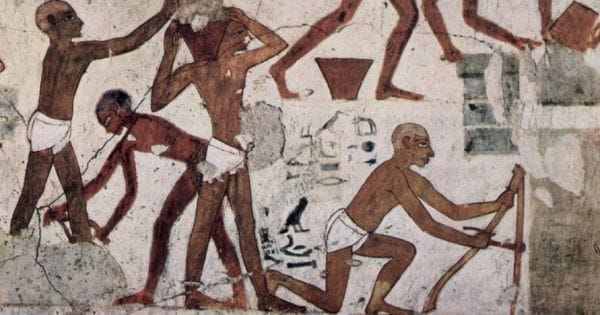
To understand how the pharaoh’s servants dared to revolt, it is best to take it step by step.
Historical context and the decline of the kingdom
It was the year 1166 BC when Egypt was governed by Pharaoh Ramesses III of the 20th Dynasty, grandson of Ramesses II “The Great.”
After 29 years of reign and at 62 years of age, the pharaoh ruled an Egypt that, despite still being a rich and powerful country, was submerged in the early stages of a period of decline stemming from various endemic and conjunctural problems:
- On one hand, on the military front, Egypt had to repel the attack of “the peoples of the north and the sea,” as well as two Libyan invasion attempts, which left the state’s coffers severely depleted.
- The monumental construction of royal tombs absorbed a considerable portion of the Egyptian population’s labor potential and organizational capacity, resulting in enormous bureaucratic growth as well as a demand for consumer goods that could not be met.
- In addition, corruption and mismanagement of resources further weakened the country’s economy, which was already strained by the monumental tombs in the Valley of the Kings.
All of this pushed the situation to the extreme that, in fact, the reign and life of Ramesses III would end in a harem conspiracy, in which his wife and important political officials would take part.
The decline intensified with his successors (8 pharaohs in 90 years), marking the beginning of the Third Intermediate Period.
Egyptian wage rights
The concept we have today of labor rights bears no resemblance to the situation of workers in those times.
We must remember that the history of Ancient Egypt spans a period of more than 3,000 years, from around 3150 BC to 31 BC (with the Roman Empire’s conquest), during which Egypt had periods of splendor and others of absolute darkness.
We are hungry, eighteen days of this month have passed… we have come here driven by hunger and thirst; we have no clothes, no oil, no fish, no vegetables. Write this to Horus, our good lord, and to the Tjaty, our chief. Let them give us our sustenance!
At the foundation of labor provision lay not only the agrarian and livestock economy. Egyptian civilization reached such degrees of sophistication and progress that it required vast logistics: quarrying of stone, metalworking workshops, the manufacture of weapons and military equipment, clothing and sustenance, shipbuilding.
And in particular, the pharaoh Horus needed to carry out major works, such as the royal mansion and his tomb. His subjects were obliged to fulfill his wishes. And in turn, the pharaoh, in order to maintain Ma’at, had to feed the worker.
This labor obligation included not only the tombs of kings, queens, and lords, but the construction of temples, fortresses, and palaces, the restoration of canals after flooding, the cultivation of temple lands and care of temple animals, and military service when required.
In short, although film and literature have shown us the vast numbers of slaves that pharaonic construction required, the truth is that, regardless of their existence, there were many free workers who provided their labor “in exchange for payment in kind” for their own maintenance and that of their families.
The workers of Deir el-Medina
During the Old and Middle Kingdoms, Egyptian kings were buried in pyramids built in the northern part of the country, near Memphis, which was the capital. But by this period, pyramids had not been built for more than 600 years.
Instead, the pharaohs preferred to build their tombs in what are known as hypogea, located in more hidden and restricted areas, easy to guard and therefore better protected from tomb robbers.

It is in the Valley of the Kings — the best-known burial site of this kind — that the tombs of most of the pharaohs of the New Kingdom are found, namely those of the 18th, 19th, and 20th Dynasties.
All the workers, craftsmen, and scribes responsible for work on the pharaoh’s tomb were housed in the village of Deir el-Medina together with their families.
The settlement contained the dwellings, chapels, and tombs of the workers themselves. There were masons, quarrymen, painters, relief carvers, and sculptors. It is estimated that in the more than seventy houses, around 120 workers lived with their wives and children.
All the work was supervised by the vizier “Tjaty,” who visited the area on some occasions or sent a royal delegate to inspect the work.
Their wages, delivered at the beginning of the working week, consisted of bread, beer, grains, dates, fruits and vegetables, drinking water, meat and fish on designated feast days, fuel, tableware, clothing, and footwear to cover the needs of the family.

The average daily wage for a worker was 10 loaves of bread and one measure of beer (2.5 jugs), while that of a highly skilled specialist could reach 400 loaves of bread that could be exchanged for other food, clothing, furniture, and so on.
Foremen and scribes received 72 sacks (of approximately 76 liters each) of grain per month, while the remaining workers received 52 sacks.
The papyrus that records the strike
As mentioned, the account of these events has reached us thanks to the so-called “Strike Papyrus,” preserved in the Museo Egizio in Turin.
Through it we know that the workers — no less than those working on the pharaoh’s tomb — were involved in what appears to have been an unprecedented event (at least there is no record of anything similar at earlier dates, neither in Egypt nor in any other civilization): they went on strike.

It appears that everything began with the corrupt management of the administrators, led by the Haty of Western Thebes [i], who had the obligation to distribute wages in kind to the workers, delaying deliveries and reducing rations by more than 20 days (2 working weeks in the Egyptian calendar), which caused great discontent. Thus, on an ostracon found in the village, one can read:
I inform my lord that I am working in the tombs of the princes whose construction my lord has entrusted to me. I am working well… I am not at all negligent. I inform my lord that we are completely impoverished… A sack and a half of barley has been taken from us and in its place we have been given a sack and a half of rubbish. (Ostracon No. 10,663, Berlin).
Although the situation was initially resolved, 3 or 4 months later the same thing happened again. Once more, the workers demanded their wages, but were paid far less than they were owed.
This led the tomb work crew to make a firm decision: to stop working and march en masse to the temple to make their grievances heard and have them conveyed to Horus [ii].
The beginning of the strike
As can be read in the Papyrus and in one of the ostraca found at Deir el-Medina (held in museums in Cairo, Berlin, and other cities), the strike began on day 10 of the month of Peret in year 29 of Ramesses III, due to the delay of payment “misappropriated” by the governor (Haty) of Western Thebes.
Year 29, second month of the second season, day 10. On this day the gang crossed the five walls of the necropolis, shouting: We are hungry! (…) and they sat behind the temple of Thutmose III at the edge of the cultivated fields. The three controllers and their assistants went to urge them to return to the necropolis enclosure, and made great promises… You may come, for we have the promise of the Pharaoh.
The royal treasury was opened and the rations for the previous month were delivered to them, but the workers also demanded the pay for the current month and, finally, on the eighth day of the strike, the month’s rations were delivered to them.
The strike was repeated up to 3 times until they managed — thanks to the visit of Vizier TA — to have the full rations delivered to them. After that, they were threatened not to demonstrate again under penalty of punishment.
The situation of the following generations — throughout the entire Ramesside period — did not improve, and the workers had to mobilize again. Sometimes the stoppages lasted only days, other times weeks or even months.
Almost always they were for economic reasons and not for working conditions. The last reports of these mobilizations date from the reign of Ramesses XI, shortly before this workers’ village disappeared.
Today, the strike is a right enshrined in the constitutions of all democratic countries. And while this movement was born in the 19th century with the Industrial Revolution, as we have seen, more than 3,000 years ago a group of men had the courage to confront none other than “The Pharaoh” — their god — to demand their rights.
Frequently asked questions (FAQ)
What exactly was “payment in kind” and what rations did the workers of Deir el-Medina receive?
Payment in kind was the common method of compensation in Ancient Egypt, as minted currency did not exist. For the workers of Deir el-Medina, it consisted mainly of essential goods for subsistence and trade. Basic rations included bread (often in large quantities, such as 10 loaves per day), beer (a fundamental part of the diet), grains (barley or wheat), dates, oil, fish, vegetables, fuel, and clothing provisions for the family.
What was the significance of the village of Deir el-Medina and why did its workers have a special status?
Deir el-Medina was unique because it housed the elite craftsmen (painters, carvers, quarrymen) responsible for building and decorating the royal tombs in the Valley of the Kings — a task of utmost religious and political importance. This gave them a higher social status than the average worker. They lived in a self-sufficient and enclosed community, which gave them an unusual sense of unity and collective power, key to daring to challenge the pharaoh’s authority.
Why is the strike of Ramesses III considered the first labor movement in history?
The strike recorded in the Strike Papyrus (Turin) during the reign of Ramesses III (circa 1166 BC) is widely considered by Egyptologists and historians to be the first organized and documented labor protest in human history. It is an invaluable testament to the fact that, despite the theocratic system, free workers could organize collectively to demand their wage rights.
Ma’at was a fundamental concept in Egyptian culture, representing cosmic order, justice, truth, and harmony. The pharaoh was the earthly guardian responsible for maintaining Ma’at. By failing to deliver full rations on time (breaking the wage contract and driving the workers to hunger), the authorities of Ramesses III were failing in their duty to uphold order and justice, which justified the workers’ action to restore Ma’at through their protest.
What other data or sources do we have about daily life and labor rights in Deir el-Medina?
The village of Deir el-Medina is one of the richest sources of information about life in Ancient Egypt. In addition to the Strike Papyrus, we have thousands of ostraca (fragments of pottery or limestone used for writing) containing work notes, attendance records, personal letters, shopping lists, and even jokes. These documents detail aspects such as wage distribution, working hours, and conflicts, offering a very human perspective on the rights and everyday problems of the era.
References
[i] The corrupt practice of delaying and reducing wage payments was carried out under the indifference or even active participation of the Haty (Governor or Mayor of the Nome). Above that authority was only the Tjaty, and above him, Horus.
[ii] Since fulfilling the wage-sustenance obligation was the primary and vital duty of the god, the workers directed themselves to the temple of Thutmose III because, almost certainly, the priests and scribes of the temple were obligated to channel the distribution through the census of workers they held.

Recommended
- Morten Meilgaard and the beer flavor and aroma wheel
- 5 design tips for developing your beer packaging