This post is also available in:
 Español
  Português
When one thinks of Japanese alcoholic beverages, sake is undoubtedly the first that comes to mind, but despite its foreign origins, beer is today without a doubt the most popular drink in Japan.
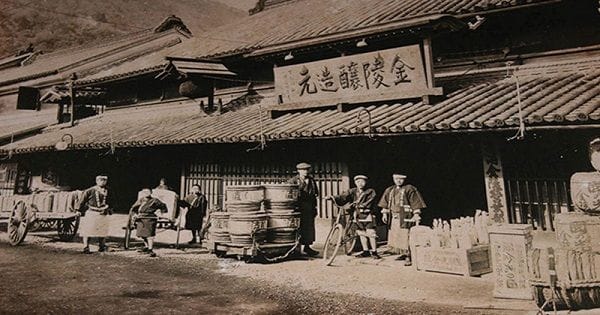

Japan is considered one of the most tolerant countries when it comes to alcohol consumption, as 66% of its population considers it morally acceptable, compared to 46% of Czechs, 41% of Germans, and 38% of Britons.
Today, despite having one of the highest alcohol taxes in the world, beer is the most produced and most sold alcoholic beverage in Japan — all of this despite the fact that home brewing is in practice prohibited (beverages over 1% alcohol) and the minimum drinking age is set at 20.
In Japan, approximately 3.5 billion liters of beer are produced each year, followed from much further behind by 500 million liters of Shochu — a distilled alcoholic spirit made from barley, sweet potato, or rice — and 425 million liters of traditional Sake, considered by many to be a type of beer in its own right, as it is made from fermented rice.
History of beer in Japan
It is believed that the first beer in Japanese history was brewed by physician Koumin Kawamoto, who in 1853 made beer at home using a Dutch brewing manual. It was never commercially released.
Beer was first introduced to Japan as a specialized import by Dutch traders in the 17th century, during the Edo Period (1600–1868).
During those years, Hendrik Doeff, the Dutch commissioner at Dejima (Nagasaki), had the supply of beer from Europe interrupted due to the Napoleonic Wars. He therefore arranged to set up a local operation to secure his own supply, opening a brewery for the sailors working the trade route.
But it was not until the late 19th century that commercial beer production in Japan began to develop, coinciding with the Meiji Period restoration (1868–1912). This also owed much to a foreign immigrant: the American of Norwegian origin, William Copeland (1834–1902), who opened Spring Valley Brewery in Yamate, Yokohama, in 1870.
A couple of years later, in Osaka, Syozaburo Shibutani became the first Japanese person to produce beer commercially, founding the Osaka Beer Brewing Company. During this era, he sent one of his most promising brewers, Hiizu Ikuta, to specialize at the prestigious Weihenstephan brewery school in Germany, one of the oldest in the world.
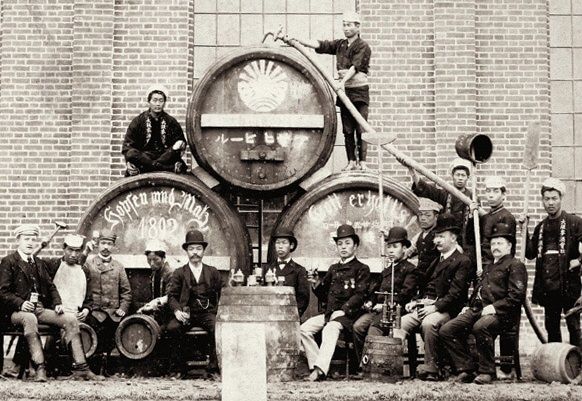
Upon his return, Ikuta would be responsible for developing and launching what is today Japan’s quintessential flagship beer: Asahi Beer.
Other brands that now dominate the Japanese market also had their origins in this period, as Kirin and Asahi are both products developed at the end of the 19th century.
At the start of the 20th century, the opening of new breweries came to a halt due to new tax laws enacted in 1901. These laws were supposedly intended to protect the local industrial beer market, but under conditions that simultaneously prevented smaller new businesses from operating.
The new laws imposed a minimum annual production requirement, tied to very high tax payments, which led many smaller operations to close — making it nearly impossible to develop any venture beyond the already established breweries.
During the 1920s, Japanese companies acquired large amounts of brewing equipment from the United States as a consequence of Prohibition, which had forced hundreds of American operations to shut down.
In the late 1950s, following World War II, Japan found itself in an era of unprecedented economic expansion, during which beer consumption rose considerably — driven mainly by the added demand from foreign occupation troops.
In that same era, in 1949, the Japanese government forced the large brewing conglomerate Dai Nipon to break up in order to prevent a monopoly in the sector.
This breakup would soon give rise to what are now Asahi Breweries and Sapporo Brewery, allowing Kirin to claim the top spot in national production — a position it would hold until well into 2001.
[amazon box=”B08QVK689C”]

The beginning of a new era
It was only in 1994 that the Japanese government decided to amend the tax laws related to beer production volumes, allowing smaller operations to function.
As a result, the government decided to apply taxes on production based on barley malt content, establishing four categories for beer:
- More than 67% barley malt
- Between 50% and 67% barley malt
- Between 25% and 50% barley malt
- Less than 25% barley malt
As expected, beer with a higher barley malt content was the most heavily taxed, which is why breweries began developing recipes with minimal malt content.

The first beer of this type was brewed by Suntory in 1994 and was very well received by the market, mainly due to its low price — which is why it was quickly imitated by other producers.
These beers brewed with other unmalted grains as adjuncts are called Happoshu (発泡酒) in Japan, loosely translated as “sparkling wine.”
The development of Japanese craft beer
The first craft brewery to open in Japan was Echigo Beer, which achieved a balance between the deeply rooted “dry” beer trend and craft brewing techniques influenced by Germany and the United States.
In addition to Pale Ale and Stout, they also developed a rice-based Lager that has managed to compete with the biggest players in the market — a kind of entry-level beer within their portfolio.
Okhotsk Beer also obtained its license in 1994 and, while not distributed globally, remains a very popular local brewery in Hokkaido.
One of the first breweries to gain international recognition was Kiuchi, a long-established sake factory that turned its attention to beer in 1996.
Its flagship brand, Hitachino Nest, is known worldwide, and they also brew a wide range of beers including the well-known White Ale.

Another very popular Japanese brewery — particularly locally — is Yona Yona Ale, produced by Yo-Ho Brewing Company, which is often considered the Japanese equivalent of Sierra Nevada or Sam Adams, and which also maintains dedicated taps for other craft breweries.
This comparison stems from the journey Japanese brewer Toshi Ishii made to the United States to hone his craft, during which he spent three years working at the renowned Stone Brewing in California.
On his return, Toshi developed a keg beer program and gradually shared his new knowledge with other brewers and bars across Japan. He founded a new brewery in 2010 called Ishii Brewing Company, in Guam.
Another award-winning brewer with strong international connections is Bryan Baird, who co-founded Baird Brewing Company with his Japanese wife Sayuri in 2000.
They started as a small brewery, but today they have several taprooms, two brewing facilities, and international recognition.
With a focus on consumer education as well as quality beer production, Baird has been an important player in helping raise the profile of craft beer in Japan.
The current craft market
Today, the number of Japanese craft breweries is estimated to exceed 200 operations, offering beers ranging from traditional Belgian styles to completely local ones, with a market share that reaches 2%. Many of them are financially linked to large sake producers, restaurant chains, hotels, and resorts.
The global connections of Japanese brewers have remained strong over the years — as demonstrated after the devastating earthquake and tsunami in Japan in 2011, when Ishii and Baird breweries, together with their former Stone colleagues, developed a collaboration beer to benefit those affected.
The resulting beer was a Japanese Green Tea IPA, which proved to be an excellent introduction to the creativity of Japanese craft brewers and a reminder that many in the global craft beer community are focused on doing good through doing well — creating unique products with a meaning that goes beyond the purely commercial.
References
- Japón y la cerveza del sol naciente
- A Brief History of Japanese Beer
- Historia de la cerveza en Japón
- History of the Japanese Beer Industry

Recommended
- The Ethics of Beer Criticism: A Necessary Reflection
- How to Drink Beer Without Getting Drunk: Jim Koch’s Secret