
This post is also available in:
 Español
  Português
  Français
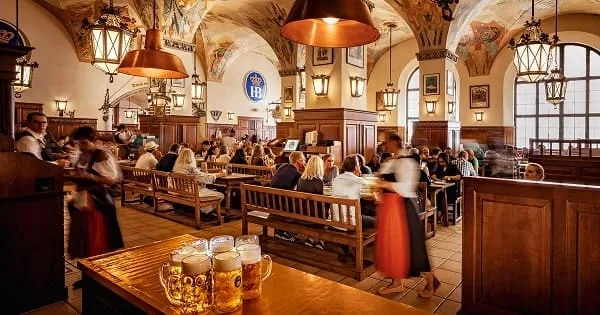
The Hofbräuhaus is one of the most famous beer halls in Munich. Duke William V of Bavaria founded it on September 27, 1589 to supply his court with beer.
The Wittelsbach family ruled Bavaria from 1180 to 1918, first as dukes and from 1806 as kings. They also reigned over the Rhenish Palatinate between 1214 and 1805.

Today the Hofbräuhaus stands at number 9 on the Platzl square, in the historic center. Its brewery, the Staatliches Hofbräuhaus, has belonged to the Bavarian State since 1852.
What Does Hofbräuhaus Mean?
Hofbräuhaus means court brewery, because for more than two centuries its beer was reserved for the Bavarian court. King Maximilian II handed it over to the State in 1852.
The crowned HB letters you see on mugs and facades have been its registered trademark since 1879. The brewery registered the emblem so that others would stop copying it.
Origins of the Hofbräuhaus
William V founded it in 1589, and at first it served only the court. In 1607 a new wheat beer brewery was built on today’s Platzl, on the same site it occupies now.
In 1632, in the middle of the Thirty Years’ War, Swedish troops were besieging Munich. On May 17 the Hofbräuhaus handed them 23,168 liters of beer as part of the tribute that spared the city from worse harm, according to the brewery’s official history.
That exclusive arrangement lasted more than 200 years. In 1828 King Ludwig I opened the Hofbräuhaus to the public with a decree that allowed it to serve food and drink to anyone.
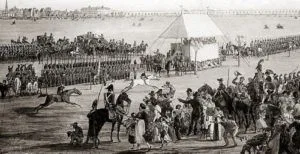
That king loved popular celebrations. His wedding in 1810 gave rise to Oktoberfest, which is now celebrated in many places around the world.
In the 19th century the brewery outgrew its home. The last brew on the Platzl took place on May 22, 1896, and production moved to Haidhausen, across the Isar, and since 1988 to the Riem district.
The current building is the work of architect Max Littmann and opened in 1897. The new Schwemme, the great hall on the ground floor, was inaugurated on February 9 of that year.
Is the Story About Peeing Under the Tables True?
A much repeated story claims that, after the opening to the public, nobody wanted to leave the table for fear of losing their seat. According to the tale, customers relieved themselves under the tables, the house cut gutters into the floor and even handed out wooden tubes so as not to splash the neighbor.

There are no documents to back it up, and it only appears in collections of beer legends. Take it for what it is, a tavern anecdote told to tourists.
What Happened at the Hofbräuhaus in 1920?
Its role as a place for political meetings made it the setting for major events. In 1919 the communist government of the Bavarian Soviet Republic set up its headquarters there.
On February 24, 1920, in front of some 2,000 people, Adolf Hitler presented the 25-point program of the German Workers’ Party at the Hofbräuhaus. That same day the party adopted the name NSDAP, the Nazi Party.
It should not be confused with another beer hall in the city. The failed coup of November 1923, known as the Beer Hall Putsch, began at the Bürgerbräukeller and not at the Hofbräuhaus.
Rebuilding the Beer Hall
Allied bombing in 1945 destroyed almost the entire building, although the Schwemme survived. Reconstruction was completed in 1958, with the reopening of the Festsaal for Munich’s 800th anniversary.
The Schwemme holds about 1,000 people and the Festsaal about 1,500. With the other rooms, the house has more than 3,500 seats and is one of the city’s main tourist attractions, especially during Oktoberfest.
The brewery still makes classic Bavarian styles. Its Hofbräu Maibock is listed in the BJCP guidelines as an example of Bock-style beers, a style that was learned precisely at the court brewery.
Its fascinating history and unique atmosphere make the Hofbräuhaus a landmark well worth visiting on a trip to Munich.
Frequently Asked Questions (FAQ)
1. When Was the Hofbräuhaus Founded?
Duke William V of Bavaria founded it on September 27, 1589 to supply his court with beer. In 1607 a new brewery was built on the Platzl, where it still stands, and in 1828 King Ludwig I opened it to the public.
2. What Do the HB Letters of the Hofbräuhaus Mean?
HB are the initials of Hofbräuhaus, which means court brewery. The crowned letters have been its registered trademark since 1879, when the brewery registered the emblem so that others would stop copying it.
3. What Was Hitler’s Connection to the Hofbräuhaus?
On February 24, 1920 Hitler presented there, in front of some 2,000 people, the 25-point program of the German Workers’ Party, which adopted the name NSDAP that same day. The 1923 Putsch did not happen at the Hofbräuhaus but at another Munich beer hall, the Bürgerbräukeller.
4. How Many People Fit in the Hofbräuhaus?
The Schwemme on the ground floor holds about 1,000 people and the Festsaal about 1,500. Counting the other rooms on the upper floors, the building has more than 3,500 seats.
5. Who Owns the Hofbräuhaus?
It has belonged to the Bavarian State since 1852, when King Maximilian II handed it over. The brewery is officially called Staatliches Hofbräuhaus in München and has brewed in the Riem district since 1988.

Recommended
- A Munich Guide for German Beer Lovers
- Munich Oktoberfest: History and Origin of the World’s Largest Beer Festival