This post is also available in:
 Español
  Português
By Paleorama
There is nothing archaeologists love more than mounds of rubbish from hundreds of years ago, since ancient bones and stones from waste heaps can tell complex stories.
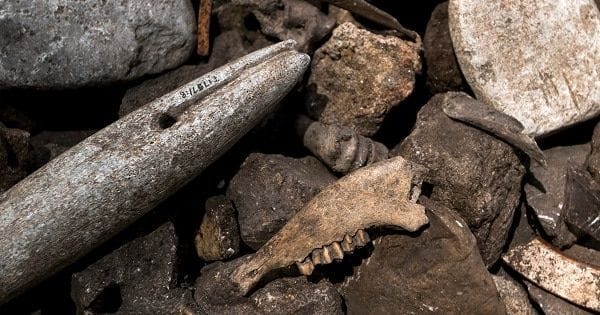
And in central Norway, it seems the story those stones tell is that Vikings and their descendants brewed beer by dropping hot rocks into wooden vessels.
History of Norwegian Farms
Much of the history of how Norwegian farms were created and developed over the millennia remains a mystery.
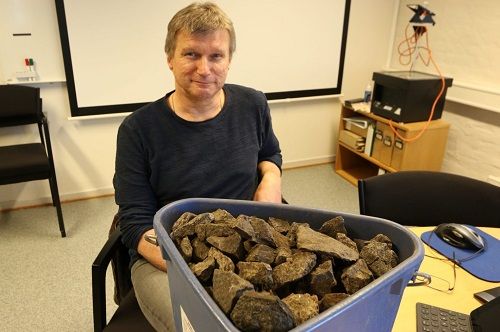
Geir Grønnesby, an archaeologist at the University Museum of the Norwegian University of Science and Technology (NTNU), says:
There are a lot of these stones and they appear in most enclosures of ancient farms.
Grønnesby is fascinated by the history of Norwegian agricultural settlements — and for good reason.
There is a simple reason for this: most archaeological excavations are tied to construction projects, because developers are required to check for cultural remains before building begins.
It is rare for a developer to run a road or major development through a farm, which means farms are rarely excavated by archaeologists.
Most of the archaeological information we have about the Viking Age comes from graves, and most of the archaeological information about the Middle Ages comes from excavations in cities. But most people lived in the countryside.
Essentially, Norwegian farms sit on a huge underground treasure — in some places dating back to around 600 A.D., toward the end of the Iron Age — and most remain intact.
So I began doing these small test excavations to look for archaeological layers on ancient farm land. The oldest carbon-14 dates I found belong to 600 A.D., and all the dates are from that time onward. And then I found the stones, and I had to write about them — because there are so many of them.
Hot Stones for Brewing Beer
Grønnesby was not the first to notice these fire-fractured stones on central Norwegian farms.
That distinction belongs to a pioneering social scientist named Eilert Sundt, who recorded an encounter on a farm in Hedmark in 1851.

As Sundt later wrote, he was walking when he saw a farmer near a pile of small stones with a strange appearance. He asked:
What are these stones for?
To which the farmer replied:
They are stones for making beer. Stones that were used for cooking and brewing Viking beer, in the old days when they had no iron vessels.
In his article, Sundt noted that most of the farms he visited had piles of burned or fire-fractured stones around them.
Every time he asked about them, the answer was the same: they were for making beer, with the stones being heated until they were “red-hot” and then dropped into ceramic vessels to heat things up.
The stones were so ubiquitous, Sundt wrote — so abundant and compacted in some places — that houses had been built directly on top of them.
Reports from archaeologists who have studied farms in recent times confirm this observation.

When an archaeologist excavated a test pit in the 1980s on a farm in Steinkjer, north of Trondheim, they found an archaeological layer more than a meter thick, composed mostly of fire-fractured stones.
Grønnesby himself excavated more than 700 cubic meters of stones in one sector of a farm in Ranheim, also north of Trondheim.
And when Grønnesby sampled 24 farms, 71% certainly or probably had layers of fire-fractured stones.
An Ancient Viking Tradition
It is not so unusual that Vikings brewed beer using stones, says Grønnesby, as this process has also been recorded in England, Finland, and the Baltic.
It is a tradition that still continues in Germany, where it is even possible today to buy “stone beer.”
The Gulating, for example — a Norwegian parliamentary assembly that met between 900 and 1300 A.D. — regulated even the smallest details of beer production and consumption of the era.
The Gulating laws required three farmers to work together to brew the beer, which had to be blessed.
An individual who failed to brew for three consecutive years had to hand over half their farm to the bishop and the other half to the king, and leave the country.
Only the smallest farms were exempt from this strict regulation.
Equally interesting is the moment when the brewing stones disappear from the archaeological record — around 1500 A.D., right at the time of the Reformation.
Grønnesby notes:
It could be a strange coincidence. It could be due to religion. Or it could be that iron vessels had become easier to come by by then.
From Rubbish Heaps to Archaeological Treasures
Every time a red-hot brewing stone was dropped into a cold container or liquid, it fractured.
After several of these cycles, the stone would be too small to keep using, and the brewers would throw it onto the rubbish heap.
This means that the thick layers of stones also contain other objects — such as ancient spindle whorls and loom weights, animal bones, and glass beads.
It is for this reason, as much as for the stones themselves, that the stone deposits are important, says Grønnesby.
Archaeologists are always finding these deposits, but they used to look at them and scratch their heads, and the deposits didn’t get the kind of recognition they deserved. These deposits represent archives from the Viking Age through the Middle Ages, so we should be excavating them more often.
Grønnesby’s research is collected in the recently published book “The Agrarian Life of the North: 2000 BC to AD 1000: Studies in Rural Settlement and Farming in Norway.”
Grønnesby’s chapter is titled “Hot Rocks! Beer Brewing on Viking and Medieval Age Farms in Trøndelag.”
Recommended
- Chicha de Jora recipe, the ancient beer of the Incas
- Who was the Michael Jackson of beer? The Beer Hunter