This post is also available in:
 Español
  Português
  Français
Brouwerij Bosteels is the brewery behind “Deus Brut Des Flandres”, a Belgian beer made in the Champagne style and also known as “the champagne of beer”.
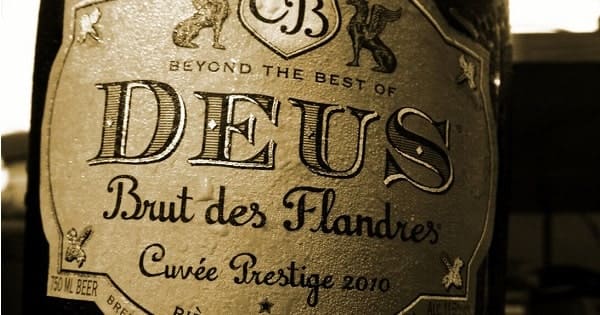
What sounds like blasphemy to some traditionalists is fascinating to others, and this beer has been a resounding success thanks to an unusual brewing method that gives it delicacy and complexity.

Since its creation, Deus Brut Des Flandres has caught the attention of beer and wine lovers alike, building a bridge between the two cultures.
This innovative approach shows how traditional winemaking techniques can be adapted to enrich the world of beer.
General Information
Name: DeuS Brut des Flandres
Brewery: Brouwerij Bosteels (Buggenhout, Belgium; part of AB InBev since 2016)
Origin: Buggenhout, East Flanders, Belgium, with secondary fermentation in the Champagne region, France
Style: Bière de Champagne or Bière Brut
ABV: 11.5%
Format: 750 ml bottle with cork and wire cage
Glassware: flute or white wine glass
The CIVC’s Fierce Opposition
Although the Comité Interprofessionnel du Vin de Champagne (CIVC) has blocked any mention of the sparkling wine on this beer’s labels, its creators describe it in these words.
The divine sparkling drink made from barley.
This controversy underlines the importance of protecting designations of origin such as Champagne, but it also shows the ability of the beer world to draw inspiration from other traditions and create unique products.
How Is Deus Brut Des Flandres Made?
This “Strong Ale” beer undergoes a second fermentation and conditioning in the bottle, just like Champagne, but it must be made very clear that it contains no wine or wine yeast of any kind.
This Champagne-style Belgian beer is brewed with the 4 ingredients found in every beer, namely water, barley, hops and yeast.
It all starts with a base beer that is filled into 750 ml bottles. Sugar and more yeast are added, and the bottle is then sealed with a crown cap.
The base beer is brewed in Buggenhout and travels in the bottle to the Champagne region, where a specialized house applies the traditional riddling and disgorging method that French rules require for sparkling wine. That round trip partly explains its price.
Using brewer’s yeast for the second fermentation is a tribute to champenoise techniques, yet it keeps the beer’s identity intact, highlighting the flexibility and diversity of Saccharomyces yeasts.
As the yeast starts working on the sugar, it releases alcohol and carbon dioxide and gradually settles to the bottom of the bottle.
The process takes between three months and a year to finish. Meanwhile, the bottles are laid horizontally so that the spent yeast collects along the side.
Champagne-Style Belgian Beer
Once this process is over, riddling or “remuage” begins, in which the bottles are gradually tilted toward the neck until they end up completely upside down.
The yeast settles into this part of the bottle, which is briefly dipped into a chilling bath until it freezes.

This delicate process ensures that no yeast remains in the finished bottle, which contributes to its crystal-clear appearance and its clean, sophisticated mouthfeel.
Once the neck is frozen, the cap is removed and the yeast shoots out as a plug of ice. The bottle is then topped up with a small amount of base beer and finished with a cork and a cage.
This technique highlights not only innovation in brewing but also the craftsmanship that every bottle of Deus Brut Des Flandres requires, which justifies its exclusivity and price.
The End Result
The result is a distinctive and sophisticated beer, with a drier texture than traditional beers and a high 11.5% alcohol content that adds body and complexity.
Its extremely fine and persistent bubbles recall those of a good Champagne, making for an effervescent and delicate experience on the palate.
Deus Brut Des Flandres unfolds a complex profile that combines subtle citrus notes, such as lemon and orange peel, with elegant floral nuances that evoke white flowers and touches of wildflower honey.
The finish is long and harmonious, leaving a fresh and subtly bitter aftertaste that invites you to keep sipping it slowly, as if it were a sparkling wine.
It is served very cold, between 2 and 4 °C, in a flute or a white wine glass, and the bottle is opened like a sparkling wine, with the cage removed and the cork held in your hand.
How Much Does It Cost and Where Can You Find It?
DeuS is sold in a 750 ml bottle and its price is far above that of any supermarket Belgian beer. In October 2026 retailers listed it at between $40 and $49 in the United States and around £25 in the United Kingdom, with frequent stockouts because production is limited.
In Spain and Latin America it shows up in specialty Belgian beer shops and some wine stores rather than in big supermarkets. It is a beer made for celebrations, just as Flanders Red Ale is made for the table, and it is worth checking the bottling date, because it is best enjoyed young.
Conclusions
Deus Brut Des Flandres is not just a beer but a sensory experience that combines the best of the worlds of beer and Champagne.
Its complexity and unique character make it an ideal choice for celebrations and special moments.
Frequently Asked Questions (FAQ)
1. What is DeuS Brut des Flandres?
It is a Belgian beer from Brouwerij Bosteels made with the traditional Champagne method. It is fermented in Buggenhout, Belgium, and goes through a second fermentation in the bottle, riddling and disgorging in the Champagne region of France. That is why it is known as the champagne of beers.
2. How strong is DeuS?
It has 11.5% alcohol by volume, the strength of a Belgian strong ale, in a 750 ml bottle with cork and wire cage. It is dry, highly carbonated and finely bubbled, so the alcohol comes across as lower than the label suggests.
3. Why can’t DeuS be called champagne?
Because Champagne is a protected designation of origin reserved for the sparkling wine of that French region. The Comité Interprofessionnel du Vin de Champagne barred any mention of champagne on the label, so the brewery presents it as Bière Brut or Bière de Champagne.
4. How should you serve DeuS Brut des Flandres?
Very cold, between 2 and 4 °C, in a flute or a white wine glass. Open it like a sparkling wine, removing the cage while holding the cork, and pour slowly to preserve the fine foam. It is a beer for aperitifs and celebrations, not for pairing with heavy dishes.
5. How much does a bottle of DeuS cost?
According to retailers checked in October 2026, between $40 and $49 in the United States and about £25 in the United Kingdom for the 750 ml bottle. It is one of the most expensive Belgian beers on the market and often sells out, because Bosteels produces limited quantities.

Recommended
- Méthode champenoise, the traditional technique behind the finest sparkling wines
- Flanders Red Ale becomes a protected geographical indication (PGI) in the European Union