
This post is also available in:
 Español
  Português
  Français
Beer can worsen fatty liver. The 2024 European guidelines recommend advising anyone with steatotic liver disease against alcohol, and the American AASLD guidance asks doctors to quantify each patient’s intake. Since 2023 specialists distinguish three conditions according to the grams of alcohol consumed per day, the metabolic disease (MASLD), the mixed form with moderate drinking (MetALD) and alcohol-related liver disease. Translated into beer, those thresholds start at around one and a half 330 ml cans a day for a woman.

For years fatty liver was split into two groups, alcoholic and non-alcoholic, a division that left no clear category for people who are overweight, have diabetes or high cholesterol and also drink moderately. The new classification measures alcohol in grams to place those people.
What Fatty Liver Is and Why It Was Renamed in 2023
Fatty liver, or hepatic steatosis, is the build up of fat inside liver cells. In June 2023 a consensus led by the American Association for the Study of Liver Diseases (AASLD), the European Association (EASL) and the Latin American Association (ALEH) replaced the term non-alcoholic fatty liver disease with MASLD, metabolic dysfunction associated steatotic liver disease.
A MASLD diagnosis requires steatosis plus at least one of five cardiometabolic risk factors, including excess weight, raised blood glucose or type 2 diabetes, high blood pressure and abnormal triglycerides or cholesterol, as the AASLD explains on its page about the new nomenclature. The change has a practical consequence for beer drinkers. Alcohol is no longer an exclusion criterion and becomes a variable that is measured.
MetALD, the Point Where Beer Becomes Part of the Problem
The new nomenclature created an intermediate category called MetALD for people with MASLD who also drink a relevant amount of alcohol. According to the AASLD, MetALD applies when a woman drinks between 20 and 50 grams of alcohol a day, or 140 to 350 grams a week, and when a man drinks between 30 and 60 grams a day, or 210 to 420 grams a week.
Above those ranges, with more than 50 grams a day in women and more than 60 grams in men, the condition is classified as alcohol-related liver disease. The 2023 AASLD practice guidance also links moderate drinking with a higher risk of advanced fibrosis in people with obesity or type 2 diabetes, so these thresholds call for particular care in anyone with metabolic risk factors. Readers who already have abnormal triglycerides or cholesterol will find more context in our analysis of beer and cholesterol levels.
How Many Beers Match Those Thresholds
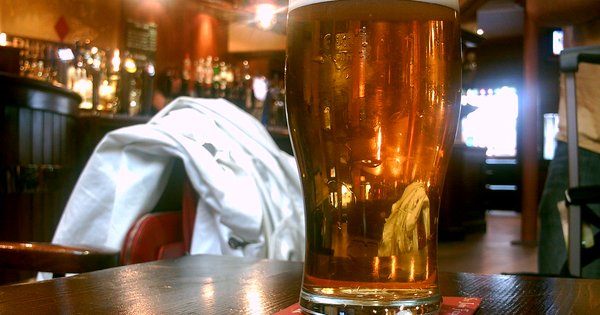
Medical thresholds are expressed in grams of pure alcohol, a unit that means little to someone ordering a beer. The calculation is simple. Multiply the volume in milliliters by the alcohol content and by 0.789, the density of ethanol. A 200 milliliter glass at 5% contains about 7.9 grams of alcohol, a 330 milliliter bottle or can about 13 grams and a 568 milliliter pint about 22.4 grams.
With those figures, the lower MetALD threshold equals one and a half 330 milliliter cans a day for a woman, about 20 grams, and slightly more than two cans a day for a man, about 30 grams. A woman who drinks three small 200 ml glasses a day, about 23.7 grams, or a man who drinks a pint and a half, about 33.6 grams, of a 5% beer is already in that range. Stronger beers reduce the margin, because a 7% IPA delivers 40% more alcohol than a 5% lager in the same volume.
What the AASLD and EASL Guidelines Recommend
The AASLD practice guidance published in 2023 states that alcohol intake should be quantified in every patient with fatty liver. It also notes that even moderate drinking is associated with a higher risk of advanced fibrosis, especially in people with obesity or type 2 diabetes, according to the text published in Hepatology.

The 2024 European guidelines, issued by EASL together with the European associations for diabetes (EASD) and obesity (EASO), go one step further. They strongly recommend discouraging alcohol in people with steatotic liver disease and call for complete and permanent abstinence when there is advanced fibrosis or cirrhosis, according to the summary published in Diabetologia. The World Health Organization makes the same point when it states that no level of alcohol consumption is safe for health.
The Case of Non-Alcoholic Beer
Neither the AASLD guidance nor the European guidelines mention non-alcoholic beer, so neither of them recommends it for fatty liver. A beer with less than 0.5% alcohol provides a very small amount of ethanol per can. The issue it raises is a different one. Some non-alcoholic beers contain considerably more sugar than regular beer, and excess sugar is one of the metabolic drivers of fatty liver, as we explain in our article on whether beer has sugar.
The decision about non-alcoholic beer depends on each patient, on their degree of fibrosis and on their metabolic control. That is why it should only be consumed after discussing it with a hepatologist or family doctor, who can assess the whole diet and not just alcohol.
Frequently Asked Questions (FAQ)
1. Does beer cause fatty liver?
Heavy drinking, including beer, can cause fatty liver on its own, and the 2023 classification calls it alcohol-related liver disease when intake exceeds 50 grams a day in women or 60 in men. In people with excess weight, diabetes or high cholesterol, smaller amounts are linked to a higher risk of fibrosis in a fatty liver of metabolic origin.
2. Can I drink beer if I have fatty liver?
The 2024 European guidelines recommend discouraging alcohol in people with fatty liver and recommend complete abstinence with advanced fibrosis or cirrhosis. The American AASLD guidance asks doctors to quantify intake in every patient because even moderate drinking raises the risk of fibrosis.
3. Is non-alcoholic beer good for fatty liver?
Neither the AASLD guidance nor the 2024 European guidelines recommend non-alcoholic beer for fatty liver. It provides very little ethanol, and many brands contain more sugar than regular beer, which also affects a fatty liver of metabolic origin.
4. How many beers a day are too many for the liver?
Under the 2023 thresholds, a woman with metabolic risk factors enters the MetALD category from 20 grams of alcohol a day, one and a half 330 milliliter cans of 5% beer. For a man the threshold is 30 grams, slightly more than two cans. For a person already diagnosed, the European guidelines advise against any amount.
5. Is beer or wine worse for fatty liver?
The AASLD thresholds are expressed in grams of ethanol and do not distinguish between drinks, so what counts is the amount of alcohol and not its format. Beer also provides carbohydrates, a factor worth discussing with your doctor in a metabolic fatty liver.
This article is for informational purposes only and does not replace advice from a healthcare professional.

Recommended
- Does Beer Have Sugar? Why Traditional Brews Have Almost None and Non-Alcoholic Ones Do
- Can Diabetics Drink Beer? How Beer Affects Blood Glucose