This post is also available in:
 Español
 Português
 Français
In the misty streets of medieval England, as the sun barely rose, chimney smoke announced that the alewives (also called brewess or brewster), the women brewers of the time, were beginning their daily ritual.
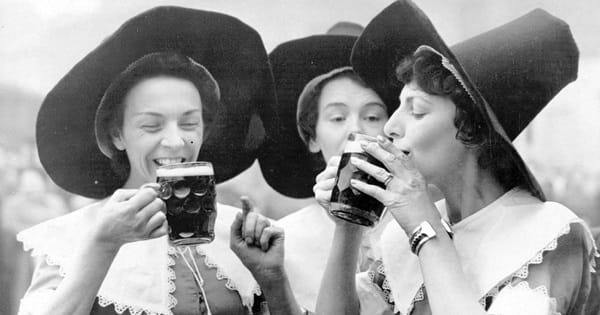
These craftswomen were the true pioneers of the British brewing industry, although their role was pushed aside once the trade became profitable and passed into the hands of men.

The Origins of an Age-Old Tradition
Until the 14th century, brewing in England was a mostly female trade in which alewives (the plural of alewife) made ale for their families and sold the surplus, turning this household activity into one of the earliest documented models of female entrepreneurship in British history.
During the Middle Ages, brewing ale (beer without hops) was as common as baking bread. Every village had its well-known alewives, who sold their product from their own homes or at local markets.
According to records from the period, daily beer consumption could reach up to a gallon (4.5 liters) per person, since beer was not simply a recreational drink but an essential source of calories. The idea that people drank beer because medieval water was undrinkable is, however, a myth.
The impact of these women on the rural economy was so significant that in villages such as Brigstock and Wakefield, in central and northern England, historical records show that up to a third of women were active brewers.
This economic independence, limited though it was, stood out all the more in a patriarchal society.
Judith Bennett brings these figures together in her book Ale, Beer, and Brewsters in England.
In Brigstock, before the plague, more than 300 women (roughly a third of the women living on the manor) brewed ale for sale. In Alrewas (Staffordshire), during the 1330s and 1340s, between 52 and 76 brewers sold ale each year (in a village of about 120 households). In Wakefield (Yorkshire), between 1348 and 1350, 185 women (almost a third of all women) brewed ale for sale.
The Assize of Bread and Ale (Assisa panis et cervisiae), a law in force during the medieval period, regulated among other things the price of ale according to the cost of grain and controlled its quality, which shows how much the alewives’ trade mattered to the economy.
Medieval Brewing
Before hops spread through England in the 15th century, many English ales were made with nothing but malt and water, with neither hops nor herbs. Others contained herbs, a custom related to the gruit of the continent, although that term was not used in England (Martyn Cornell, 2014).
That knowledge was passed down from generation to generation, often within the household itself.
At the time there was no formal knowledge of microbiology or yeast as we have today. Fermentation relied on the yeasts present in the environment and on the brewing utensils.
The trade demanded experience, because a failed batch was lost and unhopped ale did not keep for long.
Symbols and Stigma
To advertise their product, alewives placed a pole known as an ale-stake above the door, which indicated that fresh ale was available for sale.
Over the centuries, English art and literature began to portray them as cheating, sinful women, condemned to hell for deceiving their customers.
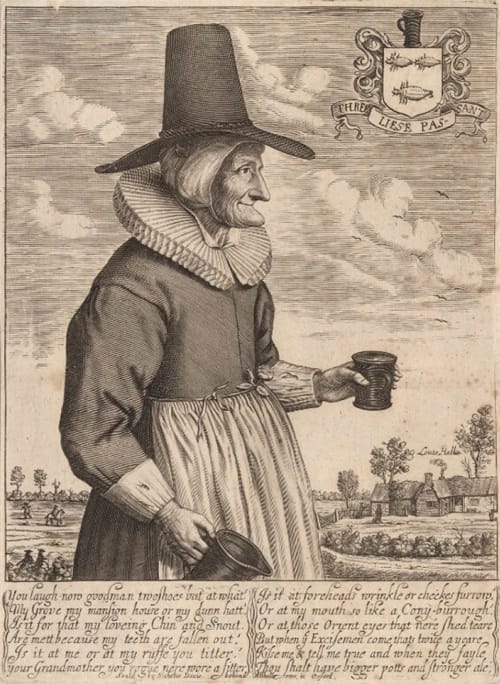
One of the best-known portraits is that of Mother Louse, a 17th-century Oxford alewife engraved by David Loggan, whose image today looks much like that of a witch.
From there came a much-repeated idea, that the pointed hat, the cat and the broom of witches come from the alewives. Beer historian Christina Wade finds no support for that connection, because the witch’s hat does not appear in images until the 18th century (Wade, 2017).

Nor is there any documented connection with the brewer’s star, a hexagram used by German brewers since at least the 15th century.
In cities such as Oxford, strict regulations gradually pushed women brewers out. A law of Edward III held husbands responsible for any harm done to a student by poor-quality ale. In 1355 the university gained jurisdiction over the city’s entire brewing trade (Museum of Oxford).
The Exclusion of the Alewives
During the 15th and 16th centuries, alewives almost disappeared from the English brewing trade. In 1501, only six widows were listed among the 23 brewers of Oxford.
The change owed more to economics than to persecution. Judith Bennett explains that after the Black Death, brewing became more regulated and more profitable, which attracted men with capital and shut out single women and widows above all.
The arrival of hopped beer from the Low Countries in the early 15th century reinforced the trend, because it was produced on a larger scale by immigrants who hired men.
A Hidden and Rediscovered Legacy
The impact of the alewives on British brewing culture lives on.
For centuries they sustained the brewing and local sale of ale throughout England.
Their role was pushed to the margins of history until research such as Judith Bennett’s brought it back.
Today, a growing movement seeks to reclaim this legacy. Modern breweries are exploring historical techniques and experimenting with traditional ingredients such as gruit.
This revival celebrates the quality of the beer but also the role of women as guardians of brewing knowledge and innovation.
Women and Beer
Alewives were much more than brewers. They sustained family and local economies for centuries, until the trade became a business in the hands of men.
So the next time we raise a glass of English ale, let us remember these women who handed down to us one of the oldest and most universal trades of humankind.
Frequently Asked Questions (FAQ)
1. What was an alewife?
She was a woman who brewed and sold ale in medieval England, usually from her own home or at local markets.
2. Why did women stop brewing in England?
After the Black Death the trade became more regulated and more profitable. Men with capital took it over, while hopped beer was produced on a larger scale.
3. Were alewives persecuted as witches?
There is no evidence of this. Art and literature portrayed them as sinners, but the idea that the image of the witch comes from the alewives has no historical support.
4. What was the difference between ale and beer?
In medieval England, ale was the malt drink without hops. Beer was the hopped version, which reached the southeast of the country in the early 15th century.
5. What was the Assize of Bread and Ale?
It was a medieval English law that regulated the price of bread and ale according to the cost of grain and also controlled their quality.