This post is also available in:
 Español
  Português
By Antony Peel
The year 2016 marked the 500th anniversary of one of the most important food regulatory laws in history.

We are talking about the Reinheitsgebot (rein = pure, heits = health, gebot = law) ordered by King Wilhelm IV, which determined the permitted ingredients in the brewing of any beer.
The three basic ingredients
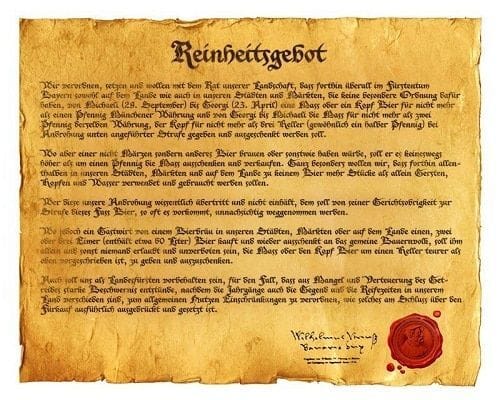
On April 23, 1516, during a meeting with the Bavarian nobility held in the city of Ingolstadt, Duke Wilhelm IV of Bavaria, together with his brother Ludwig X, issued a decree regulating both the price of beer and the brewing times and ingredients used in its production.
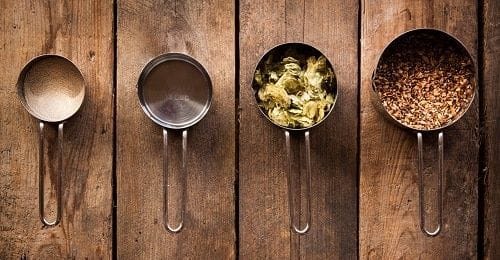
From that moment on, any beer brewed in Bavarian lands could only be produced with three basic ingredients: water, hops, and barley, prohibiting the use of any other component, such as sweeteners or malts other than barley malt.
Furthermore, we wish to emphasize that henceforth in all the cities, markets, and in the country, the only ingredients used for the brewing of beer must be barley, hops, and water. Whoever knowingly disregards or acts contrary to such an ordinance shall be punished by the court authorities confiscating such a barrel of beer without fail.
This was not the first regulation of its kind, though perhaps the most important to date, as with some small changes and adjustments it has remained in force practically to the present day, when European Union rules have introduced minor modifications affecting only beers exported to other countries, but not those intended for domestic consumption.
Predecessors of the 1516 Reinheitsgebot
Before the 1516 Reinheitsgebot, there were already other similar regulations. In 1293, the city government of Nuremberg issued an ordinance establishing that any beer brewed within its walls could only use barley as a cereal.
In 1351, the city of Erfurt in Thuringia issued a similar order, establishing the price, exact measurements, and the quantity of beer each factory could produce per year.
And in 1434, in the city of Weisensee, a law identical to the Ingolstadt beer purity law was enacted, becoming its most direct precursor.
Reasons for regulating beer production in Bavaria
We can find justifications of all kinds for the proclamation of this law. First, we must mention the economic reasons for allowing only barley as the cereal for brewing beer.

On one hand, Duke Wilhelm IV held a monopoly on barley in Bavaria, and by decreeing its use as the main ingredient, he ensured good revenues, as all beer manufacturers would have to come to him for raw materials.
On the other hand, there is a more popular economic reason that looked not only after the duke’s interests but also the welfare of the Bavarian people.
With this decree, all wheat and rye was reserved for the bakery sector, eliminating the possibility of a price war between bread and beer manufacturers, and ensuring that bread would always be available at an affordable price, as the cereals used in its production would never be scarce.
And last but not least, there were health reasons behind the enactment of this law that would guarantee consumer health and the quality of the beers produced.
It must be remembered that, before barley was used to provide the sugars necessary for fermentation and hops to flavor the beverage, all manner of herbs, condiments, and other ingredients were used — some of them even toxic and capable of causing hallucinations in those who consumed them.
We are talking about ox bile, juniper, sloe berries, oak bark, vermouth, cumin, anise, bay leaf, yarrow, jimsonweed, gentian, rosemary, tansy, St. John’s wort, ivy, bog myrtle, mugwort, horehound, heather, fir shavings, pine roots, and henbane. This law completely banned them all.
The evolution of the 1516 Purity Law
Times change and obviously, a law with more than 500 years of history cannot remain in force without being dynamic and flexible and adapting to new demands.
And so it has been: just a few years after its implementation, a special permit was granted to the Degenberg family to produce wheat beers, which was later extended to other breweries.

Over the centuries, wheat has become an admissible ingredient in top-fermented beers (though not in lager-type beers), so the malts used no longer had to be exclusively barley — this cereal could be used to keep some ancient brewing traditions alive, such as the production of Weissbier beers.
Today, it is also acceptable to add sugars to top-fermented ale-type beers.

The application of the Reinheitsgebot has relaxed over the years, especially for beers intended for export.
For domestic consumption, beers using other ingredients beyond those stipulated by the law can also be produced, with the sole condition that they are not commercialized with the word beer on their label, with the sole exception of gluten-free beers, which may call themselves beers despite including other ingredients.
Consequences of the Reinheitsgebot
Has the adoption of the German Purity Law had a positive or negative impact on the beers of this country?
It is difficult to say with precision whether the Reinheitsgebot has been good for the German brewing industry and there are opinions on all sides.
On one hand, there are those who claim that this law has slowed the adoption in Germany of some of the most popular brewing trends of the moment, citing Belgian Lambic-style beers or many American craft beers as varieties that are not acceptable under current law.
On the other hand, its most faithful defenders maintain that it is a lie that the Reinheitsgebot has limited creativity and encouraged monotony in German beers, which remain the envy of the world.
They argue that the potential that can be extracted from these four ingredients (now including yeast) has yet to reach its ceiling, and that every year German brewers are capable of producing new styles that respect a purity law that turns out to be much more liberal than generally thought.
Recent surveys among the German population support this latter view. 85% of Germans (89% in the case of young people) fully support this regulation and believe it should remain in force.
Therefore, there is no reason for German brewers to set aside this law that already has 500 years of history behind it.
We can also find protectionist as well as religious reasons. Many beers produced outside Bavaria, especially in northern Germany, used to contain preservatives and additives that were not well received in the south, especially by the Church, which considered them inappropriate because they were also used in pagan rites, in particular the herb blend known as gruit.
The negative impact of the Reinheitsgebot
Furthermore, it must be remembered that the enactment of the Reinheitsgebot led to the extinction of many other brewing traditions and local styles, such as spiced beers or those made with fruit, so typical of northern Germany.
Therefore, this law would have had a negative effect on the diversity of German beers, which would be heavily limited to the Pilsner sector.
Furthermore, since the proclamation of its original text, a fourth permitted ingredient has been added — one whose very existence was not even known in the 16th century. We are talking about yeast, discovered by Louis Pasteur in the late 19th century.
Why is the 1516 proclamation so important?
Basically because it is the first law on beer regulation applied to the whole of Bavaria, following its reunification under Wilhelm and Ludwig.
Such is its importance that its application was one of the demands made by Bavaria for the unification of Germany in 1871, and it was subsequently extended to the whole nation in 1906.
Frequently asked questions (FAQs)
1. Why was yeast not included in the original text of 1516?
In the 16th century, the existence of yeast as a living microorganism was unknown to science. Brewers of the time knew that wort fermented “magically” but did not understand the biological process. It was not until Louis Pasteur’s discoveries in the 19th century that its crucial role was identified, and it was officially incorporated into later updates of the regulation as the fourth essential ingredient.
2. How does the Reinheitsgebot affect modern craft brewing?
Many craft brewers consider the law to limit innovation, as it prohibits the use of popular adjuncts such as fruit, spices, coffee, or cacao in beers destined for the German domestic market under the name “Bier.” However, this has pushed German master brewers to perfect mashing techniques and malt and hop selection to create complex flavor profiles using only permitted ingredients.
3. Is it mandatory to comply with the Purity Law to sell beer in Germany today?
It is not strictly mandatory for all beverages, but it is for those that wish to be legally labeled “Bier” (Beer) if produced in Germany for domestic consumption. Following a 1987 European Court of Justice ruling, Germany cannot ban the sale of foreign beers that do not comply with the law, but local breweries maintain the standard as a seal of quality and tradition.
4. What happens with “Radler” beers or beer mixes under this regulation?
Mixes such as Radler (beer with lemonade) do not technically violate the “purity” of the base beer, but are legally classified as “mixed beer-based beverages” (Biermischgetränke). The Reinheitsgebot applies strictly to the production process of the base liquid before any subsequent mixing for commercialization.
5. What is the difference between the Purity Law and the “Special Bavarian Beer” certification?
While the Reinheitsgebot regulates ingredients, “Special Bavarian Beer” is a Protected Geographical Indication (PGI) by the European Union. This means that, in addition to complying with the ingredient law, the beer must have been produced in the state of Bavaria following specific traditional methods, granting it additional legal protection against imitations.