This post is also available in:
 Español
 Português
 Français
By Victor Kling
Anyone who has been lucky enough to visit a pub in England may have noticed the more traditional side of the taps behind the bar.

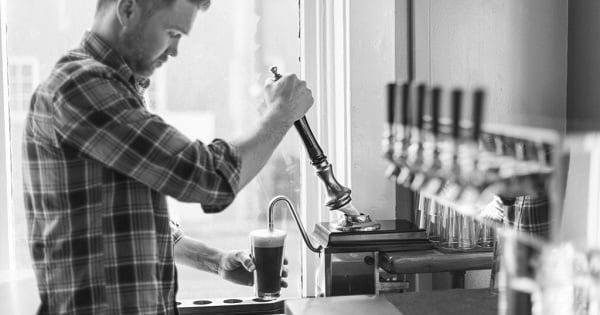
Different from conventional beer taps and slightly larger, the so-called handpumps are there especially to serve Cask Ale or “Real Ale,” as the British call it.
These beers are a classic, historic delight of the United Kingdom, a must for anyone who wants to explore the local beer scene.
What Are Cask Ales or Real Ales?
Cask Ales or Real Ales are beers made almost entirely from the four basic ingredients, which are water, malt, hops and yeast.
In a few cases, adjuncts are used, such as oats, wheat, honey, fruit and other spices.
Cask ales then go through a secondary fermentation in the very cask from which they will later be served. They are neither pasteurized nor artificially carbonated.
For these reasons, they can also be called live beer. All the gas they contain is a natural product of the two stages of fermentation carried out by the yeast.
Serving beer from a cask works differently, with no CO2 injected into the cask. The beer leaves the cask by gravity or is drawn out with a hand pump.
Serving Cask Ales
Because the line is unpressurized, pubs traditionally serve the beer through a “handpump,” which draws the beer out of the tap by suction.
When you order a cask ale in a pub, the low level of gas in the beer may seem odd. Visually, it suggests a “flat” beer, with little carbonation. But this is completely normal for cask ales and does not indicate a production problem.

A few points about the carbonation of cask ales are worth highlighting. First, the great majority of traditional British styles naturally have a low carbonation profile. Second, they undergo no additional forced carbonation.
Third and last, when the beer goes through the “handpump,” it is agitated, which knocks out even more of the little gas in the beer.
This process, however, is essential for creating the creamy head typical of Cask Ale, and it also brings out the hoppy and fruity aroma these beers usually have.
Cask ale casks are also shaped differently, with two openings instead of one, and they lie on their side rather than standing upright in the cool room.
Connecting the lines to draw the beer from the cask takes several stages. First, a small plastic or wooden piece is hammered into the side, which works as a valve to open and depressurize the cask and release excess CO2 from the beer.

Next, the plastic tap is hammered into the “mouth” of the cask, already lying on its side, where the beer will flow out by gravity.
Normally, a filter called a hop filter is fitted at the tap outlet attached to the cask. This is because, in some cases, dry hopping is done inside the cask to give the beer fresh aromas.
The filter helps achieve one of the goals of Real Ales, which is to be a very clear beer with as little haze as possible.
It is generally recommended to wait 24 hours between opening the cask and starting to serve. The beer should be kept at 11 to 13°C. Below that it can turn hazy, and above that its sensory quality can suffer.
Since the shelf life of this type of beer is relatively short, it is usually served close to where it is made. Once opened, it should be consumed within three days.
Campaign for Real Ale
The Campaign for Real Ale (CAMRA) was founded in March 1971 by Michael Hardman, Bill Mellor, Jim Makin and Graham Lees to fight the industrial processes being adopted by the big mainstream breweries.

Its members argue that “real beers” should be made and kept according to traditional methods.
Among other things, they oppose filtration, forced carbonation and pasteurization. Today, cask ales are produced by large local brands that follow these standards.
However, the “Real Ale” seal carries as much weight in terms of beer quality as the Purity Law (Reinheitsgebot) does in Germany, which is to say purely commercial.
The concept of craft beer today goes beyond rules, and that is precisely its beauty, ignoring the rules and defying logic and production processes to create wonderful beers that can delight the most varied palates.
(*) Victor Kling is a beer sommelier. You can learn more about Victor Kling’s work on Instagram and Medium
Frequently Asked Questions (FAQ)
1. What is the difference between a cask ale and a conventional keg beer?
A cask ale finishes fermenting in the cask from which it is served, unpasteurized and with no added CO2. Conventional keg beer is usually filtered or pasteurized and is served pushed by pressurized gas.
2. Are cask ale and real ale the same thing?
Almost. Real ale is the term CAMRA promoted for beer that matures in the container from which it is served, without external CO2, which also includes certain bottled beers. Cask ale is real ale served from a cask.
3. At what temperature is cask ale served?
Between 11 and 13°C, the range recommended by Cask Marque, the British body that accredits cask ale quality in pubs.
4. How long does a cask ale last once opened?
Cask Marque says to sell it within three days of putting it on sale, because contact with air soon spoils it.
5. Why does cask ale have so little gas?
It contains only the CO2 from its secondary fermentation, some of which escapes when the cask is vented and some when the beer goes through the hand pump. This is a feature of the style and not a flaw.

Recommended
- What Is Krausening? The German Technique to Carbonate Beer and Remove Off-Flavors
- What Is Beer Carbonation and How a 19th-Century Law Still Defines It