This post is also available in:
 Español
  Português
  Français
Cask-conditioned beer, also called Cask Ale or Real Ale, is not a beer style, but rather the result of a specific brewing, fermentation, conditioning, and serving process.
Regardless of the style, cask-conditioned beer must have certain common characteristics.

A Cask is a barrel-shaped container, now made of metal, used to store and serve liquids—in this case, beer.
This beer must still contain active yeast, as it will complete its secondary fermentation in the Cask, carbonating naturally.
It must also be matured, conditioned, and served at cellar temperature without the use of any artificial gas pressure.
Origin of Cask Ales
The history of cask-conditioned beer is somewhat the history of beer itself.
In books like “The Histories of Herodotus”, dating from 424 BC, there is already reference to Casks made of palm wood filled with wine or clay vessels being transported by ship to Babylon.
Later, during the Iron Age, the Celts of northern Europe developed barrels made of stronger wood bound with iron rings, which they also used to store liquids and provisions.
The British tradition of Cask Ale predates even the appearance of beer as we know it today on the islands. Surely when Shakespeare went to his favorite pub, they served his favorite Ale this way.
Traditionally, beer was usually served in wooden Casks, but as beer evolved and became paler and lower in alcohol, it also became harder to keep fresh and free from unwanted flavors.
In the late 19th century, refrigeration and pasteurization helped extend the life of beer, but they also marked the beginning of the decline of Cask Ales.
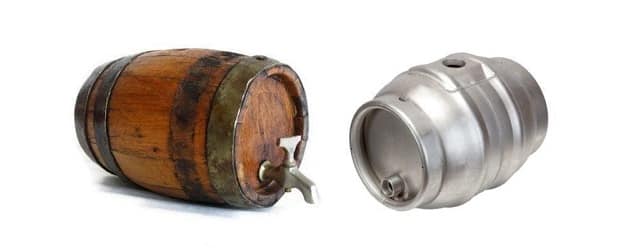
In the 1950s, wooden barrels began to be replaced by aluminum or stainless steel Casks, mainly for quality reasons—they were easier to sterilize—but also for economic reasons.
Wooden and metal Casks
Another main reason for the change from wood to metal was the reduction of oxidation caused by air.
Oxidation is one of the problems that cask beer can present and was one of the main reasons why beer was gradually no longer conditioned and served in this way.
In the 1960s, a new type of metal barrel known as a “Keg” appeared, which was much easier to clean and prolonged the beer’s life by not allowing air into the container.
By the early 1970s, most beer in Britain was filtered, pasteurized, artificially carbonated, and served from a Keg, also dispensed using CO2.
All of this meant that the beer reached the consumer’s glass with more gas and less temperature than traditional Ales, sparking a popular movement for its return.
This popular movement was the beginning of CAMRA (Campaign for Real Ale), an organization dedicated to recovering the tradition of Cask Ales, founded in 1971.
One of their most famous protest actions was staging a funeral wherever a pub was to be closed or where they stopped serving what they began to call Real Ale.
Real Ale is the name adopted by CAMRA in 1973 for a type of beer they define as:
A beer brewed with traditional ingredients, conditioned by secondary fermentation in the same container from which it will be dispensed, and served without using external CO2.
What are Cask Ales?
Real Ale and Cask Ale are the same thing. A beer with secondary fermentation in the Cask, unfiltered and unpasteurized, served at cellar temperature without using CO2, and dispensed through a handpump or by gravity.
The main characteristic of cask-conditioned beer is the presence of yeast that is still active.
It does not matter whether it is at cellar temperature or served by gravity or handpump; if it is not conditioned in the Cask itself, it is something else.
Real Ales must always complete their secondary fermentation in the Cask.
Casks are designed for this purpose. Today, almost all are made of stainless steel, although there are also aluminum ones, and some wooden ones still survive.
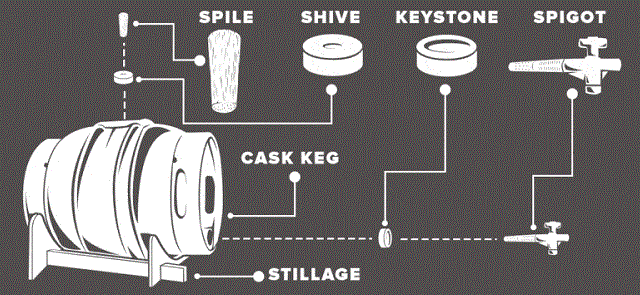
It is barrel-shaped, wider in the center than at the edges, which allows the sediment resulting from secondary fermentation, called “Lees,” to settle in the widest part.
They have a hole in the belly, through which it is filled and breathes, plus another hole in the top or bottom, through which it is served. This bottom hole is called the “Keystone” and is where the tap is inserted for service.
Once filled, a plastic or wooden plug called a “Shive” is placed in the hole, which is perforated to accommodate a smaller plug called a “Spile,” hard or soft depending on the Cellarman’s needs.
The Cellarman’s role
In short, the Cellarman is the person in charge of conditioning the beers. Their role basically consists of:
- Adjusting the CO2 level in the Cask to ensure adequate carbonation and allowing finings to do their work.
- Ensuring proper maturation according to the beer style.
- Securing the Cask in its final serving position, avoiding shaking that could make the beer cloudy.
- Serving the beer at the optimal temperature and with the best serving method according to the style and the brewer’s recommendations.
Mark Dorber, one of the most recognized and respected Cellarmen in the industry, is very clear about the fundamental role of his position:
They must promote the greatest possible beauty in each barrel of beer by developing the most interesting range of sounds, aromas, and flavors, always nurturing high levels of natural carbonation where possible, consistent with each style, and on the other hand, serving each beer in a way and at a temperature that enhances its aroma and flavor profile and creates an appropriate mouthfeel.
The Cellarman must know the beer in their charge and be able to handle it, keeping the barrels in the correct position and at the right temperature, adding fining agents when necessary, and/or dry-hopping if customers demand it.
Brewing, conditioning, and serving
The brewing process does not differ much from any Ale except at the end of primary fermentation, when the beer is transferred to a Cask, leaving behind most of the yeast but carrying enough in suspension to continue its work in a secondary fermentation in the Cask.
The sizes of these Casks vary greatly, but without a doubt the two most used are the “Firkin” (72 pints or almost 41 liters) and the “Kilderkin” (144 pints or almost 83 liters).
Once filled, “Finings” are added to clarify the beer, and sometimes sugar is also added to intensify the secondary fermentation.
At the same time, dry hops are also added if dry-hopping is intended. The most traditional English fining is “Isinglass,” a protein extracted from fish swim bladders.
Then, a soft wooden peg or “Spile” is fitted into the hole of the plug on the top of the container to allow some of the gas created by the secondary fermentation to escape.

As fermentation slows down, this porous peg is replaced by a more rigid one that keeps the gas inside the cask to condition the beer and give it sparkle.
Conditioning is the stage in the brewing process when the beer matures, clarifies, and carbonates.
A common perception in the homebrewing community is that bottle- or cask-conditioned beer is better simply because it is naturally carbonated.
But that is only half the story, as conditioning and carbonation are not the same thing.
Conditioning involves much more than carbonation, which is just one element of the conditioning process.
What is important is the fact that secondary fermentation takes place in the same container from which it will be served, producing a new set of flavors, aromas, and other characteristics that are diminished in beer conditioned by other means.
For example, many esters that are normally aerated during fermentation are trapped in the barrel and dissolve into the beer, affecting overall flavor and aroma.
Typically, once it arrives at the pub, the Cask is allowed to rest while the yeast gradually settles in the belly of the barrel.
Real Ales are best kept at a cellar temperature between 10 and 13°C and usually clarify after 24 to 48 hours.
The Casks are vented through the Spile, allowing excess CO2 to escape; this is where the Cellarman’s technique, using more or less porous Spiles, allows the beer to reach its optimal carbonation and maturity.
When the Cellarman believes the beer is at its best, it is served at a temperature between 10 and 13°C, via handpump or by gravity.
This way of serving beer exposes it to oxygen, which means it must be consumed quickly once the barrel is tapped.
Although the first phases of oxidation can appear in just a couple of days.
To control this condition, there are “Cask Breathers” that allow purging oxygen from the Cask at the end of the day, thus avoiding contact between the beer and oxygen, although this type of device is frowned upon by CAMRA, which is totally opposed to its use.
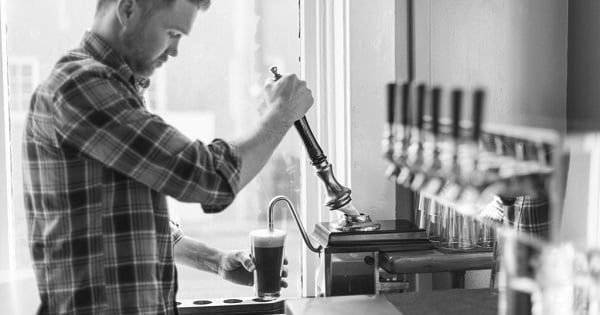
When served by gravity, a tap is inserted directly into the Cask; when not, it is served using a handpump.
This device pushes the beer out of the Cask, pumping air inside, which gives it a fuller, creamier body that makes the Ale smoother and more pleasant.
There is also a screw-on attachment for the handpump nozzle called a “Sparkler” or diffuser. Diffusers create artificial foam by reducing CO2 in the beer and should only be used in certain styles (like Stouts) or if the brewer requires it.
The main reason they should not always be used is that diffusers aerate the beer, providing sweeter aromas and flavors and a rounder palate.
This means that, for example, hoppier Pale Ales lose hop aroma and flavor.
They can also be used to mask poor conditioning if the beer has been over-aerated or has not carbonated well.
A diffuser should not be used to artificially create foam; if the Cellarman does their job correctly, using it should be a matter of preference, not necessity.
Myths about Cask beers
Despite the typical image of British beers, cask beers should not be served warm or without foam.
A good head and the resulting Belgian lace are signs that both the brewer and the Cellarman have done their job well.
The fact that the beer is unfiltered also does not mean it should be cloudy. If a cask-conditioned beer is left at the proper temperature and given enough time for the suspended particles to settle, it should arrive in the glass completely clear, except for styles that should not be, of course.
So, in case you ever feel like you are being deceived, the first thing to know is that there is no foolproof method to know for sure, but there are some things to look out for and some faults that may be passed off as characteristics.
1. Observe the beer
Evaluate the mouthfeel and appearance. Natural carbonation provides a smooth texture and a creamy head.
2. The beer is too clear
If you see them moving a Cask to tap it and the beer comes out clear when they start serving, it probably has no yeast and is not Cask Ale.
3. The beer is too cloudy
It is most likely that the beer has not had enough time to settle, that the yeast is still working, or that it has some kind of contamination. In the latter case, it will be accompanied by unpleasant flavors.
4. The beer gives a jolt when served
It may have dry-hopping, but it is still a sign that the beer has not had time to settle and condition properly.
5. The beer is lukewarm and has no gas
Carbonation is a little softer, but it should always have gas. And at 11°C the beer may not be cold, but it is cool, so it should not be lukewarm.
6. The beer has strange aromas and/or flavors
If the beer has unpleasant aromas like vinegar or tastes excessively of butter or cardboard, it may have a defect or contamination. This type of fault is unacceptable in any type of beer.
Frequently Asked Questions (FAQ)
1. What is the difference between a Cask beer and a Keg beer?
The main difference lies in processing and pressure. While a Keg contains filtered, pasteurized, and artificially carbonated beer with external CO2, a Cask contains “live” beer with active yeast. In a Cask, the gas is generated naturally through secondary fermentation inside the container and is generally served by gravity or handpump, without adding external gas pressure.
2. Why is Cask Ale served at a higher temperature?
It is served at cellar temperature (between 10 and 13°C) because excessive cold (4-6°C) would inhibit residual yeast activity and “dull” the complex malt nuances and fruity esters of natural fermentation. At this temperature, the texture is silkier and the aromatic profile is much more expressive and authentic.
3. How long does a Cask of beer last once opened?
Because the serving system allows air (oxygen) to enter for the beer to flow, a Cask Ale has a very short shelf life. Ideally, it should be consumed within 48 to 72 hours of being tapped. After this time, oxidation begins to degrade the flavor, bringing cardboard or vinegary notes that ruin the experience.
4. Is Real Ale suitable for vegans?
Not always. Traditionally, Isinglass, a gelatin obtained from the swim bladders of certain fish, is used to clarify the beer in the Cask. Although there are now synthetic or vegetable alternatives (such as Irish moss), many traditional British producers still use Isinglass, so vegan consumers should check the label or ask the Cellarman.
5. Do Cask Ales have more calories than industrial beer?
Not necessarily due to the packaging method, but rather due to their density. Cask Ales usually have a fuller body and a higher amount of nutrients and yeast in suspension, which can slightly increase the caloric content compared to a highly filtered and diluted industrial Lager. However, since they have no added sugars for artificial carbonation, the difference is usually minimal.