This post is also available in:
 Español
  Português
  Français
The IPA glass was created from an original and novel design that sought to push the limits of the tasting pleasure of this style.
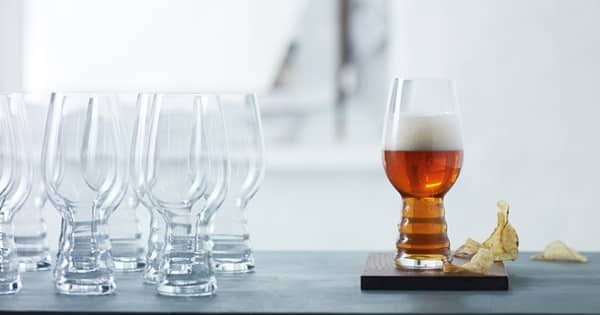

Developed in 2013 through a collaboration between the German glassware company Spiegelau and two of the leading companies of the craft beer movement in the United States, with Sam Calagione from Dogfish and Ken Grossman from Sierra Nevada.
The final design was established through a series of design workshops and professional tasting where more than 100 different shapes were tested.
The choice, by secret and unanimous vote, ended up selecting the glass called No. 6, from which the prototype was developed.
Characteristics of the IPA Glass
Its base has a series of curved edges that allow the beer to be properly aerated and a high concave rim that captures aromas better.
Next, a thin body to extend the serving temperature and a laser-etched bottom that creates a constant flow of bubbles from the bottom to maintain active carbonation and a foamy head.

In short, this new glass allows you to best appreciate the complex and seductive aromatic profiles of the IPA style, preserving a foamy head, intensifying the flavor and mouthfeel through a wide and comfortable opening.
Its capacity is 540 ml (19 oz), its diameter is 82 mm, and its height is 186 mm.
Recommended Styles
- English IPA
- American IPA
- Speciality IPA
- Double IPA
- New England IPA
- Red IPA
- Brown IPA
Frequently Asked Questions (FAQ)
1. Why does the IPA glass have that fluted or wavy shape at the base?
The fluted base of the IPA glass serves a crucial mechanical function during serving and consumption. Every time you tilt the glass to drink and return it to its upright position, the waves create turbulence in the liquid. This movement gently remixes the beer, releasing volatile hop compounds, pushing them towards the concave top so you can appreciate them with each sip.
2. What does it mean for a glass to have a laser-etched bottom, and how does it affect the beer?
The laser etching on the bottom of the glass creates what is technically known as a nucleation point. This microscopic, deliberate imperfection alters the surface tension of the liquid, forcing the constant release of carbon dioxide in the form of fine columns of bubbles.
3. Can the IPA glass be washed in the dishwasher, or does it require hand washing?
Although glassmakers like Spiegelau indicate that their platinum glass glasses are dishwasher safe, hand washing is strongly recommended if you wish to preserve the tasting properties. Common dishwasher detergents and rinse aids leave an invisible chemical film that breaks the surface tension of the beer, instantly destroying foam retention. Additionally, extreme heat and friction can wear away the laser-etched nucleation point on the bottom.
4. What is the correct way to wash and dry this glass so as not to ruin the beer’s foam?
To keep the glass in optimal tasting condition, wash it using warm water and a neutral, perfume-free soap, or ideally, just water. Gently rub with a sponge intended exclusively for glassware (to avoid food grease residue). Finally, rinse very well with cold water and let it air dry upside down on a rack, avoiding kitchen towels that could transfer lint or threads that interfere with the glass’s active carbonation.
5. If I don’t have a specific IPA glass, what other type of glass is the best substitute?
If you don’t have the technical IPA glass, the best substitute is a Tulip glass or, failing that, a large Snifter glass. Both designs share with the IPA glass a rounded base that allows you to hold it and subtly warm the liquid, along with a narrow neck towards the top that concentrates the esters and essential hop oils, preventing the complex aromas of the style from dispersing quickly into the environment.