This post is also available in:
 Español
  Português
It is often said that the fresher, the better — and beer is no exception. Fresh ingredients are important for flavor and quality, with hops being one of the most distinctive ingredients in this regard.


Certainly, we were not the first to add freshly harvested hops to a beer recipe — it is something that has been done for hundreds of years. However, countless beers in the United States and around the world owe their existence to the addition of fresh hops, also called “wet hops.”
Fresh Hops vs. Wet Hops
The two terms are not necessarily mutually exclusive. While brewers and beer drinkers tend to use them interchangeably to mean the same thing, fresh hops generally refer to hops that are used immediately after drying, while wet hops never reach this point in the process.
Vinnie Cilurzo of Russian River Brewing describes the difference between fresh hops and wet hops in Stan Hieronymus’s book “For the Love of Hops“:
Both do a great job, but you get more fresh aromas and flavors when the product is wet, requiring a larger volume to compensate for the water they still contain.

Michael Jackson described one of the most influential commercial beers in the United States around 1996, Sierra Nevada’s Northern Hemisphere Harvest Ale, as:
A beer with a slight touch of malt sweetness at the start, which then gives way to a wave of clean, refreshing, resinous, almost orange peel-like flavors, and finally a defined bitterness that whets the appetite.
Wet hops not only impart different flavors and aromas, but they are also delicious when used correctly.
There are some keys to brewing excellent wet hop beers and a few more things to understand about them in order to maintain that wet hop friendliness in your homebrew.
Wet hops contain approximately 80% water, so you will need to use more than you would normally use with dry hops.
In general, you need four to six times more wet hops by volume than dry hops.
For example, one ounce of dry pellet hops would be equivalent to four to six ounces of wet hops. That is the idea.
On the other hand, wet hops take up more space in the kettle — enough to consider reducing batch size depending on the total amount of hops and the size of your brewing system.
They will also add more water that must be taken into account when calculating original and final gravity.
Hop Freshness Is Everything
When Ken Grossman, founder and CEO of Sierra Nevada Brewing, began homebrewing, he had great difficulty finding quality hops and noted:
The homebrewing trade consumed an insignificant amount of hops and apparently, in the eyes of growers and merchants, was not worth their while.

However, there has been a resurgence in hop cultivation since the “crisis” of 2008, making it easier for commercial brewers and homebrewers to obtain locally grown hops or simply grow their own.
Once harvested, wet hops literally begin to rot because the cones contain a high percentage of water, which is why farmers transport them directly from the field to the brewery — or in your case, from your backyard to your kitchen.
It is important to use wet hops within days of harvesting, preferably within 24 hours, so they do not risk spoiling and ruining your process.
Using Hops in Moderation
Like all good things, wet hops should be used in moderation, as they can quickly reach a breaking point where the once-desired “grassy” aromas and flavors remind you of chewing a salad.

Other undesirables include notes of tobacco and chlorophyll, to name a few.

Remember, you are adding a large amount of green matter to your homebrew. These flavors will be acceptable up to a point, but brewing requires balance and an awareness of the desired style.
This is a good reason to use dry hops for the bittering portion in the boil and wet hops for aroma and flavor.
If you try to increase bitterness with wet hops, you risk losing their nuances.
Using dry hops for bittering also reduces the volume of hops in the kettle and allows you to work with hops of known alpha acids.
You really do not know how much bitterness you will get from hops grown in your backyard, and using them near the beginning of the boil can produce unpredictable IBUs and an even more unpredictable beer.
The Hop Life Cycle in Wet Hop Beers
1. Hops Before the Kettle
The value of hops lies in the essential oils they produce, which make up as much as 4% of the hop cone.
These oils increase during the weeks leading up to harvest and continue to evolve after the hops are dried and stored.
In Stan Hieronymus’s book “For the Love of Hops“, he references recent research that monitors the dramatic changes in hop essential oils in the days before harvest and suggests that wet hops may produce different compounds than dry hops.
However, no similar studies have been conducted on wet hops. “This is not a scientific exploration of brewing,” says Jamie Floyd, co-founder of Ninkasi Brewing. “What is the economic benefit of analyzing a beer brewed just once a year?”
2. Hops in the Boil
Hops are used during the boil because high temperatures activate many of their components, but a side effect is that this same phenomenon drives off some of the most desirable essential oils.
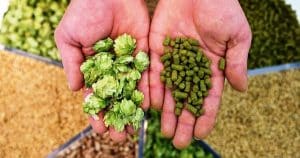
Therefore, brewers who want to know how much bitterness they are adding may choose to use dry hops with already measured and known alpha acids.
Those interested in preserving oils such as linalool and geraniol should add wet hops toward the end of the boil or during the whirlpool.
3. Hops in the Fermenter
The effect of adding hops during fermentation is not conclusive. However, we know that something happens because we have tasted the differences — the results of biotransformations of hop compounds that occur in the presence of yeast.
There is another reason to believe that wet hop beers will taste different. All you need to do is keep tasting them.
At 24 hours into fermentation, the beer will still taste very green, but over time the beer will begin to open up and the oils will start to come through in the aroma and flavor.
4. Hops at Bottling
Most homebrew contains residual pieces of hops because most homebrewers cannot or do not want to pay for a centrifuge, so the flavor will change over time after packaging.
Another source of quality decline can be poor oxygen control during the bottling process, which will damage any beer — especially hoppy ones.
References
- Hieronymus, S. (2012). For the Love of Hops: The Practical Guide to Aroma, Bitterness and the Culture of Hops. Brewers Publications.
- Palmer, J. J. (2017). How to Brew: Everything You Need to Know to Brew Great Beer Every Time (4th ed.). Brewers Publications.
- Janish, S. (2019). The New IPA: Scientific Guide to Hop Aroma and Flavor. Scott Janish.
- Grossman, K. (2013). Beyond the Pale: The Story of Sierra Nevada Brewing Co. Wiley.
- Alworth, J. (2021). The Beer Bible (2nd ed.). Workman Publishing Company.

Recommended
- Historic Belgian beers and the revival of some styles
- English Strong Ale vs. American Strong Ale: style references