This post is also available in:
 Español
  Português
Although the source of the legend of Gambrinus is uncertain, it seems to have originated in the Netherlands of Western Europe during the Middle Ages (13th century).
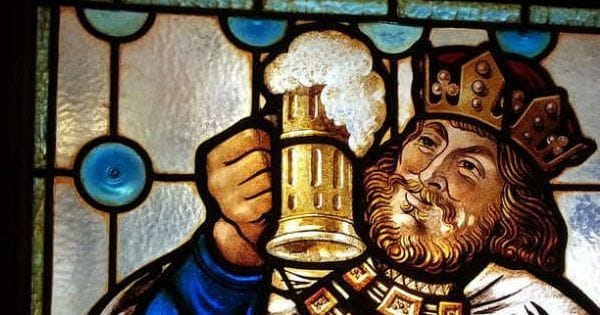
Two men have mainly been proposed as the primary inspirations for the appearance of Gambrinus: Jan Primus (John I), Duke of Brabant, and Jean Sans Peur (John the Fearless), Duke of Burgundy.
Several theories have been presented about the Latin etymology of the term “Gambrinus.” It could be considered a lexical evolution from the conjunction of the name Jan Primus in the inevitable fusion and evolution of its components as a compound word, Cambrinus or Gambrinus.
Also noteworthy is its possible origin in the word “Cambarus” (cellarman), itself derived from the Celtic term “Camba” (broth for making beer) or from the contraction of the words in the expression “Ganeae Birrinus” (one who drinks in a tavern).
Contenido
- Jan Primus of Brabant
- Jean Sans Peur of Burgundy
- Gambrivius in the German “theory”
- Legends of European folklore
- The legend of Gambrinus
- Gambrinus as king of beer
- Frequently Asked Questions (FAQ)
- 1. What real historical difference exists between Jan Primus of Brabant and Jean Sans Peur of Burgundy within the legend?
- 2. What is the most accepted etymological explanation for the transformation of the name Jan Primus into Gambrinus?
- 3. Why does the German version by Johannes Aventinus place the origin of beer in Ancient Egypt?
- 4. What role does hops play in the narrative structure of the deal with the devil, according to Charles Deulin?
- 5. What is the cultural significance of the beer barrel replacing Gambrinus’s body upon his death?
- Recommended
Jan Primus of Brabant
One of the most probable origins of the Gambrinus legend is based on the life and works of Jan Primus (1251-1294), Duke of Brabant, a character well recognized in his domains as handsome, kind, a lover of women, and a great benefactor, mainly due to the measures adopted to alleviate hunger in his lands through the cultivation of barley.

Jan Primus was indeed well known for his love of beer and became an honorary member of the brewers’ guild in Brussels.
Brabant was a state of the Roman Empire that encompassed Brussels, Germany, and Belgium; it was very prosperous due to beer brewing.
It was precisely in Brussels that Jan Primus laid the foundations for the European beer industry, allowing the mayors of Brussels to grant licenses for the brewing and sale of beer.
Jan Primus is also considered to be the one who introduced malt beer to Central Europe and who started the social custom of proposing a toast.
Belgian writer Victor Coremans has highlighted the similarities between Jan Primus’s appearance on his tomb and the faces of Gambrinus in some ancient illustrations.
Jean Sans Peur of Burgundy
Later, born almost 80 years after the death of Jan Primus of Brabant, emerges as the heir to the popular and brewing legend of his predecessor, with whom he would eventually become confused: John I, Duke of Burgundy (1371-1419), better known as Jean Sans Peur (John the Fearless), in whose duchy, a short distance from Brabant, beer was also produced.
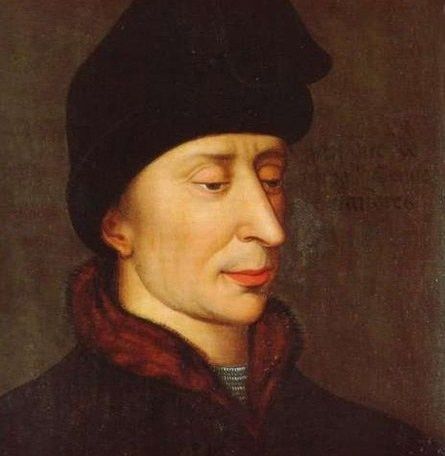
Jean Sans Peur is credited with the introduction and legalization of hops in the county of Flanders, where, like in many other European territories, beer was brewed with a mixture of herbs called Gruit.
Why John instituted hops in Flemish beer is not documented, but he lived at a time when hops were legalized in nearby jurisdictions.
It is also said that he instituted an order of merit called “Ordo Lupuli” (“Order of the Hop”).
Gambrivius in the German “theory”
In his Annals Opus Magnum of Bavaria, German historian Johannes Aventinus wrote that the legend of Gambrinus is based on a mythical Germanic king named Gambrivius, to whom the gods supposedly taught how to brew beer.
In Aventinus’s chronicle, Gambrinus was supposedly born in 1730 BC—in the middle of Egypt’s 13th dynasty—and was a lover of Isis, sister of Osiris, who, according to some older legends, invented beer.
It is through this association with the gods that Gambrinus supposedly learned the science of brewing.
Legends of European folklore
According to one of the many popular legends that mask his historical figure, Gambrinus had a confrontation with the devil, and from that scuffle they agreed to a challenge in which they bet that Gambrinus would not be able to make a wine without grapes, which supposedly gave rise to the first beer.
It is said that Gambrinus lived 300 years ingesting enormous quantities of beer as his only food source and that before dying he declared:
If I had drunk more beer, I would have lived even longer.
Another legend relates that at the dawn of the 12th century, the brewers of Brussels were deliberating over which strong, brave man would deserve the honor of being their leader.
Thus, they organized a competition in which one had to move a large barrel of beer.
Among all those who participated in the competition, we again find the Duke of Brabant, Jan Primus, a man of great strength and considerable intellect who, with obvious joy, witnessed the useless efforts of the other competitors to move the beer barrel.
When his turn came, he ordered one of his servants to place a tap in the barrel’s mouth. Jan lay down under the barrel, opened the tap, and drank until all the beer was gone.
Once empty, he easily lifted the barrel and carried it to the finish line without much effort.
Faced with such intelligent behavior, the brewers of Brussels named Jan Primus as the honorary ruler of their guild.
Over the centuries, the legend continued and transformed the clever Duke of Brabant into Gambrinus, known for his unconditional love for a beer stein, who would drink beer for three days straight, stein after stein, without stopping.
According to another medieval fiction, it is said that after the fierce Battle of Worringen (with which he annexed the Duchy of Limburg), Jan Primus invited all his allied nobles to celebrate the victory.
During the celebrations, Jan approached an inner courtyard where his soldiers and servants were partying and decided to give a speech to those brave young men.
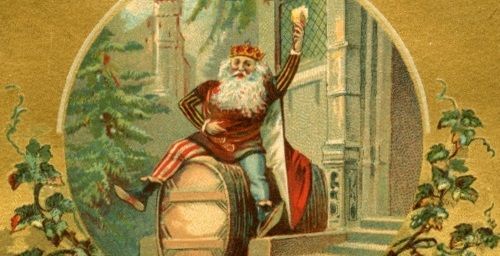
Jan climbed to the top of a mountain of barrels and sat astride the highest one. Raising his foaming stein, he called the attention of those present and proposed a toast to those lands and the health of their people.
Thus, the social custom of proposing a toast at important celebration events supposedly originated.
The legend of Gambrinus
In his 1868 anthology titled Contes d’un Buveur de Bière (Tales of a Beer Drinker), Charles Deulin, a French writer, journalist, and theater critic, wrote a short story called “Cambrinus, Roi de la Bière” (Cambrinus, King of Beer), in which “Cambrinus” makes a deal with the devil.
In this version of the legend, Gambrinus, a handsome but poor apprentice glazier, falls in love with Flandrine, his boss’s daughter. But when he declares his love, she rejects him, saying:
Not until you become a man with status.
With a broken heart, Gambrinus leaves his city in an attempt to forget Flandrine, traveling with his violin, an instrument for which he had great talent.
He soon becomes known throughout Belgium and Holland, so when the people of his hometown hear of this famous musician, very proud, they beg him to return.

Thus, Gambrinus returns and gives his first concert. His performance is incredible, until he spots Flandrine in the crowd again and chokes.
His music becomes horrible, and the crowd goes mad to the point of causing serious disturbances.
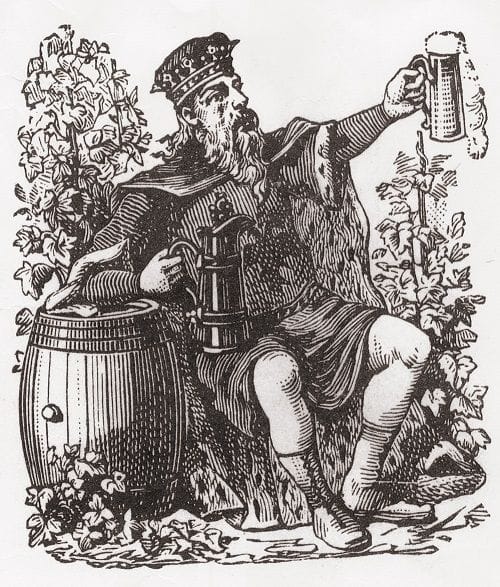
Gambrinus is declared responsible and taken to jail. It is there that he concludes that his life is not worth living and, wounded by love, decides to take his own life.
Just before hanging himself, the devil himself appears to him dressed as a hunter and proposes a deal. In exchange for his soul, for 30 years, he would obtain a gift that could help him win Flandrine’s love.
And if this gift did not work, the devil would give him a remedy to forget his beloved forever.
Gambrinus agrees to give up everything if Flandrine falls in love with him, but the devil tells him that love is the only thing beyond his control but that he can basically do anything else.
Then give me something to forget her.
A request to which the devil agrees, signing a contract for his soul.
The next day, upon leaving jail, Gambrinus feels a strong desire to gamble. This new passion, with the devil’s help, makes him a very rich man, but he still cannot forget Flandrine.
He decides to go once more to Flandrine to declare his love, letting her see that he is now a very rich man, but she rejects him again:
I don’t care if you have money or not. You are still nobody. Come back when you are a duke or a king.
Gambrinus leaves the city again very depressed and meets with the “hunter” for the second time to explain that his love of gambling had not made him forget Flandrine and asks if he could do anything else for him.
Do you see those plants over there? I will show you how to use them in a drink called beer.
This time, the devil teaches Gambrinus to build a brewery and brew beer and gives him seeds to grow hops.
The devil also gives him the ability so that anyone who hears his wonderful music cannot stop dancing.
Gambrinus returns to his hometown, grows hops, builds his brewery, and practices on his carillon.
When he has finished preparing his first brew, he calls all the inhabitants of his town who had humiliated him at his last concert to the market square to taste it.
At first, none of them like this new bitter drink, and they mock him again. It is at that moment that Gambrinus begins to play his carillon, and automatically everyone begins to dance, keeping them thus for several hours until everyone is very thirsty.
When the music finally stops, they return to the beer and cannot stop drinking it, enjoying it even more with each sip. Gambrinus and his beer are a success, and the news spreads quickly.
Gambrinus as king of beer
The new drink spreads throughout the country, and the king of the Netherlands even rewards him with a title: Duke of Brabant.
Although Gambrinus himself prefers to use the unofficial title of King of Beer, he spends his days drinking and throwing parties.
Finally, Gambrinus is not only rich but also a man who moves in the highest circles of society.
Flandrine, who had secretly come to love Gambrinus but was too proud to admit it, waits for the duke to return a third time to ask for her hand, but since Gambrinus does not visit her again, she decides to go to him.
Once in front of Gambrinus, Flandrine extends her hand to him, but he does not recognize her, thinking she is just someone else who wants to try his beer. He hands her a glass and turns away without paying her any more attention.
Beer had finally made Gambrinus forget Flandrine, just as he had always wished.
Time passes, and for 30 years Gambrinus lives the good life, but then the devil returns to collect his soul as they had agreed.
When he sees him, the drunken Duke decides to welcome him with the music of his carillon, resulting in the devil himself not being able to resist it and beginning to dance.
After several hours, the devil begs Gambrinus to stop, even if it means breaking the contract for his soul.
Thus, the happy Gambrinus regains his freedom and gives the devil a barrel of beer, which he finishes in one gulp, very angry, before returning to hell, claiming that he will be back for his soul after Gambrinus dies.
The King of Beer lives almost 100 years in drunkenness until he finally dies, and the rumor reaches hell.
The devil eagerly comes to collect his soul, but when he arrives at the place where Gambrinus has died, he finds only a barrel of beer instead.
Thus, the Devil finally accepts that the King of Beer’s soul will never be his.
Frequently Asked Questions (FAQ)
1. What real historical difference exists between Jan Primus of Brabant and Jean Sans Peur of Burgundy within the legend?
Jan Primus of Brabant and Jean Sans Peur of Burgundy belong to different times and territories, although medieval popular tradition ended up merging their identities. Jan Primus, who lived in the 13th century, provided the political foundation by granting the first commercial licenses to brew beer in Brussels, in addition to being remembered for his physical strength and for promoting barley cultivation to combat famines. On the other hand, Jean Sans Peur, born almost eighty years after the death of the former, went down in history for a transcendental technical and botanical milestone: the legal introduction of hops in the county of Flanders to replace gruit, a mixture of herbs that had dominated European production until then.
2. What is the most accepted etymological explanation for the transformation of the name Jan Primus into Gambrinus?
The most solid linguistic hypothesis suggests that the term “Gambrinus” is the result of lexical evolution and phonetic deformation of “Jan Primus” over the centuries in Western Europe. By joining the proper name Jan with the Latinizing adjective Primus, the expression gradually derived into compound words such as Cambrinus, facilitated by the pronunciation of Germanic and Flemish dialects of the time. There are complementary explanations linking the term with the Latin word “cambarus,” used to designate cellarmen, which in turn comes from the Celtic root “camba,” which referred to the hot broth used in the early cereal boiling processes.
3. Why does the German version by Johannes Aventinus place the origin of beer in Ancient Egypt?
The Bavarian historian Johannes Aventinus attempted to give a dynastic and divine background to the Germanic brewing tradition, connecting it with classical mythology in his work Opus Magnum. According to his chronicle, the central character was not a medieval nobleman but an ancient king named Gambrivius who supposedly lived around 1730 BC. Aventinus constructed a story where this monarch became the consort of the Egyptian goddess Isis, allowing the Eastern divinities, traditionally associated with the invention of the first grain ferments in North Africa, to directly transmit to him the secrets of agriculture and hop manipulation.
4. What role does hops play in the narrative structure of the deal with the devil, according to Charles Deulin?
In the work Contes d’un Buveur de Bière, written by Charles Deulin in 1868, hops are not just a botanical ingredient but function as the magical element and the definitive remedy that the devil gives to resolve the protagonist’s conflict. When Gambrinus fails in his attempt to buy Flandrine’s love through gambling wealth, he demands an absolute mechanism for forgetting. The introduction of hops to create beer symbolizes the transition from the bitterness of unrequited love to a brew that captivates society, finally granting him the status of Duke of Brabant and freeing him from the romantic obsession that had driven him to the brink of suicide.
5. What is the cultural significance of the beer barrel replacing Gambrinus’s body upon his death?
The denouement of the French legend, where the King of Beer’s corpse mysteriously transforms into a wooden barrel, represents the folkloric apotheosis of immortality through craft. By leaving neither a physical body nor a soul that the devil can claim for hell, the story establishes that Gambrinus became eternally fused with his own creation. This literary motif consolidates his figure not as a common mortal but as a pagan patron saint of tavern keepers and brewers, whose spirit remains alive in every tavern in northern Europe through the social act of toasting.
Recommended
- Yeast flocculation and clarification: everything you need to know
- Mango michelada recipe, ingredients and step by step