This post is also available in:
 Español
  Português
It was January 24, 1935, when the first canned beer went on sale after decades of experiments and more than a decade of Prohibition in the United States. The Gottfried Krueger Brewing Company brought its long-awaited product to market in Richmond, Virginia.
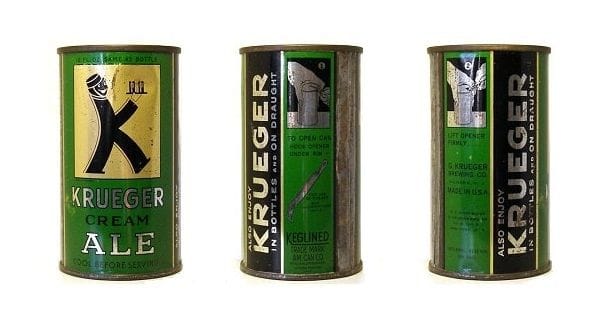
To begin with, Gottfried Krueger was a German immigrant living in Newark, New Jersey, who had arrived from Germany in 1853 and began working in Newark at the Adams & Laible brewery, which had been established on Belmont Avenue in 1851.

Gottfried Krueger and the American Lager
In the years that followed, Krueger learned the trade of master brewer producing Ale, Porter and Stout — the classic beer styles of the era. But the growing wave of European immigration was demanding a lighter, German-style beer.
This is how German immigrants began producing American-style lager.

A few years later, by 1865, Krueger already owned his own brewery. Lager triumphed and became the national drink.
Production went from 750,000 barrels in 1850 to 39 million in 1900. Brewery buildings now took on a Victorian style to emphasize the grandeur of German-American brewers.
The First Canning Experiments
As far back as 1909, the American Can Company had been running experiments to can beer, but they ran into a major problem: beer at the time was unfiltered, which meant it sometimes continued carbonating inside the cans until they exploded.
Shortly after, when Prohibition took effect on January 17, 1920, American Can halted its testing.
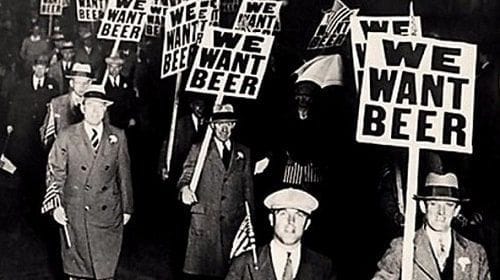
The outbreak of war in Europe in 1914 had already worsened the situation for German-American brewers, who were being viewed as unpatriotic and pro-German.
It was hardly the right climate to push the project forward. Some of these brewers pivoted to producing soft drinks and dairy products instead.
But not all of them. Krueger, unsurprisingly, launched his own beer — Krueger’s Old Essex Brew — containing less than 1% alcohol as permitted by law and a flavor close to that of traditional beer.
It wasn’t until 1933, with the repeal of Prohibition, that American Can finally managed to produce a pressurized can with a special interior lining, preventing the beer from reacting with the tin — similar to what was already being done with kegs.
However, the original idea is attributed to Krueger’s brewery, which had already been running canning trials for two years under a brutal prohibition on alcohol that had lasted more than a decade.
Sadly, Krueger did not live to see his project on the market, nor the end of Prohibition — he died in 1926.
The First Beer Can in History
On January 24, 1935, the new product made its debut: a canned beer that finally solved the storage problem and eliminated the need to return bottles.

The new cans chilled faster, and the brewery was able to sidestep the heavy taxes on kegs that had come into effect after the end of Prohibition.
Success was immediate. Krueger’s Finest Beer sold by the thousands — though these first cans were nothing like what we know today. They were flat on top and had to be opened with a can opener.
The steel used to make them wasn’t replaced until 1958, when aluminum became the standard. And the pull tab? That didn’t come along until 1960.
The Introduction of the Pull Tab
The pull tab — also known as a ring pull or stay tab — was a revolutionary invention that forever changed the way we consume canned drinks.
It was introduced by Ermal Fraze, an engineer from Dayton, Ohio, who patented his design in 1963. However, the first trials and commercial implementation began in 1960.
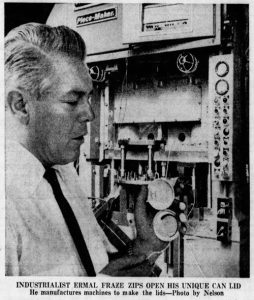
Fraze got his inspiration during a picnic in 1959, when he realized he had no can opener to open a can of beer.
That inconvenience led him to devise a system that would let people open cans easily, without any additional tools.
The first company to adopt the system was the Pittsburgh Brewing Company, which began using pull-tab cans in 1962.
The innovation was an instant hit. It offered greater convenience to consumers and eliminated the need to carry a separate opener.
It also provided a more secure seal, helping to preserve the beer’s freshness and carbonation.
Design and Evolution
Over the years, the pull tab design has evolved considerably. In its early days, the tabs were of the “pull-tab” variety — they detached completely from the can when opened.
However, this design created problems with litter and injuries, as the detached tabs could be accidentally swallowed or cause cuts.
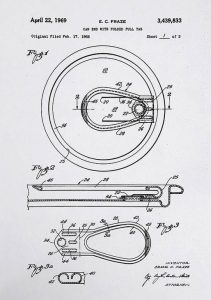
In the 1970s, the “stay-on tab” was introduced — the design that remains attached to the can after opening. This version, which is the one we know today, solved the earlier problems and became the industry standard.
The pull tab not only revolutionized the canned beverage industry, but also made its mark on popular culture.
Its ease of use and iconic design turned it into a symbol of modernity and convenience in the way we consume drinks.
References
- Smith, G. (2014). Beer: A Global History. Reaktion Books.
- Baron, S. (1962). Brewed in America: A History of Beer and Ale in the United States. Little, Brown and Company.
- Ogle, M. (2006). Ambitious Brew: The Story of American Beer. Harcourt.
- Van Wieren, D. P. (1995). American Breweries II. Eastern Coast Breweriana Association.
- Jackson, M. (1998). The New World Guide to Beer. Running Press.

Recommended
- How is the beer bitterness index (IBU) calculated in a laboratory?
- The brewer’s star: A symbol of tradition, alchemy and quality