This post is also available in:
 Español
  Português
When religion permeated everything, major transformations appeared even in the most mundane matters; that is why when the Protestant Revolution reduced the power of the Catholic Church, beer was much more than a pleasure drink.
In the 16th century, drinking water was a risk, but since beer was boiled and incorporated antibacterial herbs and spices, it was the healthy option. Moreover, its other ingredients were nutritious, so it supplied the calories that the poorest people needed.
What Was the Protestant Reformation?
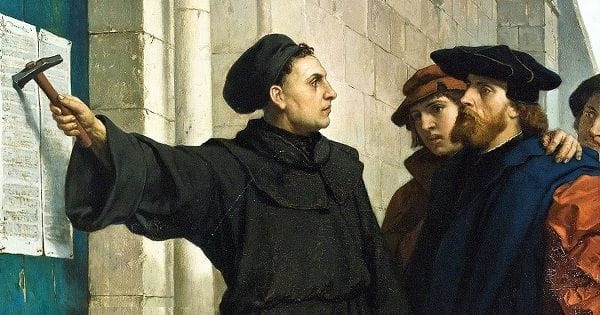
The Protestant Reformation was a religious, cultural, and political movement that began in the early 16th century, led by figures such as Martin Luther in Germany.
Its initial purpose was to reform the practices and doctrines of the Catholic Church, especially the sale of indulgences and the role of the clergy.
However, its repercussions were far deeper, giving rise to new Protestant churches, weakening papal authority, and causing major social, economic, and cultural transformations across Europe.
The Catholic Church’s Monopoly
For this reason, beer was consumed by everyone and at all hours of the day in various regions of Europe. And whoever controlled beer production was the Catholic Church.
The then all-powerful religious organization held the monopoly on gruit, a mixture of herbs and spices (such as yarrow, ground ivy, heather, rosemary, juniper berries, ginger, cinnamon) used to flavor and preserve beer.
However, there was a plant with a lovely pale green cone-shaped flower that grew abundantly and served perfectly as a substitute for gruit. It was hops. So why weren’t they using it?
The Role of Hildegard of Bingen
A year before Luther published his critique of Rome and the Catholic Church that launched the Reformation, the state of Bavaria had already enacted a law dictating that beer could only be brewed with hops, water, and barley.
But the Bavarian law of 1516, and above all the attempts to have it adopted in other regions of Germany, initially met with some resistance.

One reason was that Hildegard of Bingen, the 12th-century German mystic and abbess, had declared that hops “saddened a man’s soul and weighed upon his internal organs.”
And, well, if the Sibyl of the Rhine and the Teutonic prophetess — who in fact remains so admired that Pope Benedict granted her the title of Doctor of the Church in 2012 — tells you something is not very good for you, you probably pay attention.
However, if you are part of an uprising that challenges everything the Catholic Church represents, you are more than willing to reconsider what until then had been your truths.
In the case of beer, this meant that what had been considered an undesirable weed began to be appreciated. The Reformation gave it a major boost.
The Tax Revolution
Hops had several advantages. First, Humulus lupulus was not taxed. And besides being tax-free, it was an excellent preservative, which, among other things, allowed the product to be shipped to distant places without issue.


Curiously, another virtue was precisely what had previously been considered its vice: its sedative properties. The brews prepared by the Church could be quite potent and their effect on those who drank them was not in line with the Protestant character.
All these reasons, combined with the simple desire to defy the Church, led Protestant brewers to begin using hops instead of gruit herbs. It was thus that the Catholic Church gradually lost control of beer.
“Can we say that Protestantism explicitly promoted the use of hops?” asked William Bostwick, author of “The Brewer’s Tale: A History of the World According to Beer,” in conversation with the NPR media organization.
He himself answers no. But did it encourage the use of hops? Very likely, yes.
The Formidable Katherine von Bora
What is beyond doubt is that Luther was not only fascinated by beer, but that it played an important part in his life.
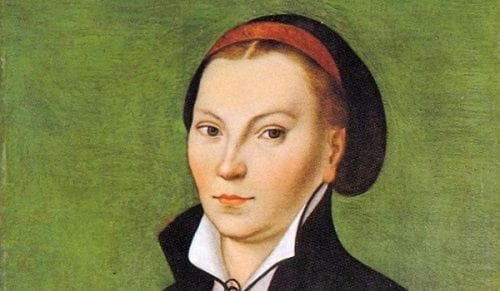
Luther wrote about his wife, a fugitive nun named Katherine von Bora:
I still think of the good wine and beer I have at home, along with a beautiful wife.
Katherine not only bore six children and managed the large Luther household with its endless flow of guests, but also planted an orchard and fruit trees, raised cows and pigs, kept a fish pond, and opened a brewery that produced thousands of pints of beer a year.
Although her husband’s delight was undeniable, at times the monk seemed to despise beer, going so far as to describe the German taste for the drink as:
Such an eternal thirst that, I fear, will remain Germany’s plague until the last day.
But despite Luther’s protests, his glass was always full.
Days before his death in February 1546, in one of his last letters to his wife, he praised the beer of Naumburg for its laxative properties. Luther suffered unbearable agonies from constipation and with immense satisfaction announced his “three depositions” that morning.
Frequently Asked Questions (FAQ)
1. Was the use of hops a technological innovation or an ideological decision?
Although hops were already known as an ingredient, their widespread adoption was driven both by their preservative properties (technology) and by the desire to break dependence on Church-controlled gruit (ideology).
2. What impact did the transition from gruit to hops have on the European economy of the 16th century?
The decline of gruit reduced the Catholic Church’s revenues, while hops allowed small producers and Protestant cities to become independent, boosting interregional trade (since beer was better preserved), laying the groundwork for the modern brewing industry.
3. How did the symbolism of beer change before and after the Reformation?
Before the Reformation, beer was tied to monastic tradition and was seen as part of the spiritual and physical sustenance provided by the Church. After the Reformation, it also came to represent economic independence, regional identity, and a break from ecclesiastical authority.
4. How did the Reinheitsgebot influence the development of beer?
The 1516 purity law restricted beer ingredients to water, barley, and hops, laying the foundation for brewing quality standards in Europe. It was instrumental in establishing hops as the dominant ingredient, long before other regions adopted it on a large scale.
5. What role did Katherine von Bora play in this story?
Beyond being Luther’s wife, Katherine managed a domestic brewery that produced large quantities for her family and guests. Her role demonstrates how Protestant women could occupy an active place in the domestic economy and beer production after the Reformation.
[amazon box=”B0BSWPQ91K” description_items=”0″]