

This post is also available in:
 Español
  Português
Sahti is an ancient beer originating from Finland, recognized as one of the oldest beer styles to have been continuously brewed. It stands out for its unique flavor, traditional brewing process, and rustic character.
Finland boasts vast boreal forests, thousands of lakes, and a brewing tradition that dates back to prehistoric times, with roots that may even trace back to the Viking era.
Contenido
Origin and History of Sahti
The first documented records of sahti date back to 1366, when it was mentioned in a document detailing the amount of beer consumed during the burial ceremony of a bishop in Finland.
However, archaeological evidence suggests that this beer was already part of the region’s brewing tradition long before this written record.
For example, in the 1930s, a sunken Viking ship was discovered near the coast of Norway, containing wooden barrels dating back to the 9th century.

It is believed that these barrels held sahti or a similar variety, such as koduõlu (Estonia), gotlandsdricke (Sweden), maltøl (Norway), or kaimiškas (Lithuania). This reinforces the theory that these beers were already part of daily life in ancient Nordic societies, long before written historical records.
Sahti is deeply connected to the rural traditions of Finland, particularly in the western regions of the country.
For centuries, this beer was primarily brewed in homes, mostly by women, who were considered the master brewers.
Like other traditional beverages, the sahti recipe was passed down through generations within families and villages, preserving its authenticity and its place in everyday life.
Records in the Kalevala
Finland’s brewing tradition is also reflected in the Kalevala, a literary work compiled in 1835 by Elias Lönnrot but believed to be linked to an oral tradition dating back to the Iron Age.
No se encontraron productos.
The Kalevala contains approximately 400 verses directly referencing the art of brewing beer, stating:
Osmotar, the beer preparer,
brewer of refreshing drink,
takes the golden grains of barley,
takes six grains of barley,
takes seven tips of hop fruit,
fills seven cups with water,
places the cauldron over the fire,
boils the barley, hops, and water,
lets them soak, boil, and bubble,
thus crafting the delicious beer,
on the hottest days of summer,
on the misty promontory,
on the forest-covered island;
pours it into birchwood barrels,
into oakwood casks.
Ingredients and Brewing Process of Sahti
Sahti is known for its rustic and artisanal production process, which has endured for centuries in rural Finland, using local ingredients and methods that preserve its authenticity.
The basic ingredients of this beer include barley and rye, grains historically cultivated in Finnish lands that contribute to its characteristic flavor.
1. Grains, Herbs, and Spices
The traditional process began with the germination of the grains, which were soaked in water in a sack placed in a stream.
The grain was then dried or smoked in a sauna. Wild or cultivated plants such as yarrow, bog myrtle, caraway, and other herbs similar to gruit were used for flavoring.
Hops only began to play a minor role around the 14th century when their use spread across Europe, gradually replacing many of the herbs once included in recipes, except for juniper.
2. Use of Hot Stones
The brewing of sahti involved a heating process that did not bring the wort to a boil. First, stones were heated in a fire and then submerged directly into the wort.
This gave the beer its characteristic smooth flavor and avoided excessive caramelization of sugars, contributing to a dense and robust body.
3. Use of Juniper
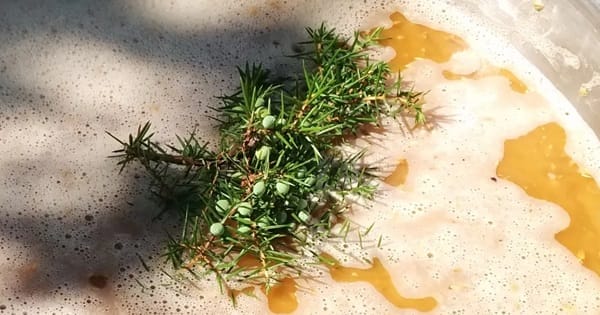
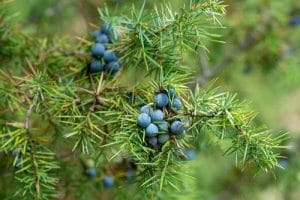
Juniper branches and berries have always been essential in its brewing, not only for their organoleptic characteristics but also for their antimicrobial properties.
During wort filtration, juniper branches were traditionally placed at the bottom of a vessel called a kuurna—a carved wooden trough with a plug at the bottom—to act as a natural filter for the wort.
4. Fermentation
Originally, sahti was fermented using wild yeast, a type of open fermentation characteristic of many ancient beers, where microorganisms present in the air or ingredients played a key role.
Over time, with the evolution of brewing techniques, Finnish baker’s yeast began to be used, achieving similar results.

This yeast allowed for more precise control over fermentation, resulting in a more consistent flavor profile while retaining the beer’s unique character.
The fermentation process for sahti is shorter than that of other beers, typically lasting 2 to 5 days. It is then transferred to wooden barrels, where it continues to mature, softening the flavors and enriching the beer’s texture.
5. Final Characteristics
One of the most notable features of sahti is its minimal carbonation, unlike many other beer styles.
This gives the beer a smooth, dense, and sticky texture, with a mouthfeel that makes it truly unique.
A beer brewed with unboiled wort has a short shelf life, but when fresh, it offers an exquisite malt and cereal flavor.
Due to the retained proteins, it also feels nutritious, smooth, and full-bodied—a rustic and refreshing approach that makes sahti a special beer experience, ideal for those seeking something authentic and close to its historical roots.
Appearance and Organoleptic Characteristics
Its appearance can range from yellow to dark brown, and it is typically a cloudy, hazy beer with very little foam development due to its low carbonation, giving it a smooth drinking experience.
Its aroma is intense, with a malty and sweet character, slightly grainy, with notes of caramel, rye, and subtle alcoholic hints. Banana and clove notes stand out, along with a subtle presence of juniper, which adds a woody and piney spiciness.
The flavor of sahti mirrors its aroma, with a base of sweet malts, lightly caramelized like toffee, complemented by moderate banana and clove notes and low bitterness.
The mouthfeel is thick, viscous, and dense, owing to its high protein content from the unboiled wort.
Homebrew Sahti Recipe (20 Liters)
Original Gravity: 1.097 (23°P)
Final Gravity: 1.034 (8.5°P)
ABV: 8.0–8.5%
Ingredients
- 7 kg Pilsner malt
- 2.4 kg Munich malt
- 0.6 kg roasted rye malt
- 10 g juniper branches
- 25 g fresh baker’s yeast
Instructions
- Mash the grains at 60°C for 45 minutes using 2.3 liters of water per kilogram of grain. Mix the juniper branches into the wort.
- Raise the temperature to 70°C for 45 minutes, then to 80–85°C for 15 minutes. Begin lautering and recirculate until the wort runs clear.
- Sparge with water at 80–90°C until 20 liters of wort are collected. If using an immersion chiller, insert it into the hot wort at the start of lautering to sanitize it.
- Cool the wort to fermentation temperature. Dissolve the fresh yeast in a small amount of cold water or rehydrate dry yeast in water at 40°C. Pour all the wort into the fermenter, as the wort is not boiled and there is no trub.
- Add the yeast and ferment at 18–25°C until fermentation begins to slow, 1 to 3 days. When the beer still tastes slightly sweet but not cloying, move the fermenter to a cold environment. Ensure the gravity is within the range of 1.034–1.038.
- Condition cold for 7–10 days, storing in a cool place at all times and occasionally releasing pressure if necessary until most of the yeast has settled.
The Importance of Sahti in Finnish Culture
Although commercial beer consumption became popular in Finland during the 19th century, sahti has managed to survive thanks to its strong connection to rural traditions.
Even during Finland’s prohibition years (1919–1932), sahti continued to be produced on a small scale in homes, helping to preserve it to this day.
Over the decades, sahti has experienced a revival, particularly after the founding of the Finnish Sahti Society in 1989, an organization dedicated to promoting the history, culture, and preservation of this ancient beer.
In 2015, sahti received TSG (Traditional Specialty Guaranteed) and PDO (Protected Designation of Origin) recognition, helping to protect its authenticity and ensure that recipes and brewing methods are respected in commercial production.
Although the commercialization of sahti has grown in recent years, it remains a symbol of Finnish identity and a testament to the region’s rich brewing tradition.
Whether you decide to brew it at home or enjoy a commercial version, sahti will always take you on a journey through Finland’s history and culture.
No se encontraron productos.
We recommend
- What is Cider? History, Production, Varieties, and Main Characteristics
- Global Guide to Indigenous Beers: 8 Varieties to Discover