This post is also available in:
 Español
 Português
 Français
The origins of beer are believed to go back to the ancient civilizations of Mesopotamia, a drink rich in tradition that has evolved constantly over the centuries.
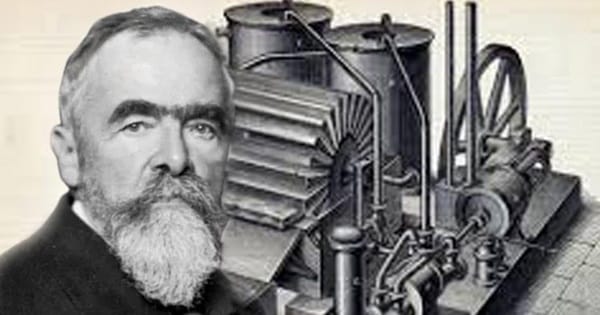
One of the most significant milestones on this path of innovation is the revolution in brewery refrigeration, driven by the German engineer Carl Paul Gottfried Linde, whose invention not only transformed the brewing process but was also crucial for the development and spread of lager beers around the world.

The Historical Context of a Need
During the 19th century, beer production in Europe, particularly in Bavaria, was subject to strict regulations that since 1553 banned brewing during the warm months, specifically between St. George’s Day (April 23) and St. Michael’s Day (September 29).
This rule was a response to health concerns arising from high temperatures, which could cause uncontrolled fermentations and unpleasant flavors in the beer, severely limiting brewers’ ability to innovate and produce consistently.
The repeal of this law in 1850 allowed brewers to brew all year round. Even so, keeping beer in good condition remained a considerable challenge, because heat could quickly damage the quality of the product, a context that became the breeding ground for the innovation Carl von Linde would lead.
Who Was Carl von Linde?
Carl von Linde was born on June 11, 1842, in Berndorf, a small village near Thurnau in Bavarian Upper Franconia. He studied engineering at the Zurich Polytechnic, where he became interested in thermodynamics, although he left in 1864 without graduating after taking part in a student protest.
In 1868 he joined the Munich Polytechnic School as a lecturer, the forerunner of today’s Technical University of Munich, where he was appointed professor of mechanical engineering in 1872.
In 1870 and 1871 he published articles in the Bayerisches Industrie- und Gewerbeblatt, the Bavarian journal of industry and trade, on how to improve cooling machines, texts that caught the attention of brewers who needed to keep their product fresh during the warm months.
The Scientific Foundations
Linde approached refrigeration from the standpoint of thermodynamics, looking for a compression machine that would remove more heat per unit of work than those of his time.
His first prototype, built between 1871 and 1873 by Maschinenfabrik Augsburg with the backing of Gabriel Sedlmayr of the Spaten brewery, used dimethyl ether as its refrigerant.

That first model leaked refrigerant through its mercury seal. Together with Friedrich Schipper, Linde then developed a new machine using compressed ammonia, a gas with better refrigerating properties than ether or carbon dioxide.
This system used a compressor to raise the pressure of the ammonia until it turned into a liquid, which then evaporated in a heat exchanger, absorbing heat from its surroundings and producing the cooling effect.
Commercial Development
The dimethyl ether machine was installed at the Spaten brewery in Munich, although its commissioning was only documented in January 1874 and it never worked reliably.
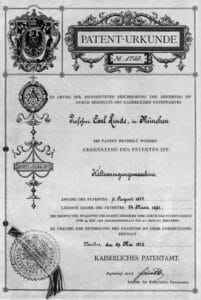
Linde applied for the Bavarian patent on the ammonia machine on March 25, 1876, while the German imperial patent, number 1250, was granted to him in August 1877.
The first ammonia compressor was sold in 1876 to the brewery that the Dreher family, the same family behind Vienna Lager, owned in Trieste, then part of the Austro-Hungarian Empire. It ran there from 1877 until 1908.

Refrigeration Technology
Once the ammonia machine was up and running, orders from other breweries followed. Heineken, in the Netherlands, received one of his machines in 1877, while Carlsberg, in Denmark, got one the following year.
By the end of the 1870s, Carl von Linde had become a leading figure for the brewing industry. In 1879 he gave up his professorship to found the Gesellschaft für Linde’s Eismaschinen in Wiesbaden, the Linde Ice Machine Company, the origin of today’s Linde.
By 1890 the company had sold 747 refrigeration machines, most of them to breweries and cold storage facilities across Europe, which cemented his reputation as a pioneer in the field.
Carlsberg, one of the most notable breweries to adopt his technology, had been founded in 1847 in Copenhagen by J.C. Jacobsen, known for his innovative spirit and his focus on cold fermented lager beers.
Artificial cooling allowed the brewery to control fermentation and lagering temperatures all year round, which improved the quality and consistency of its beer.
How Did It Change the Brewing Industry?
The introduction of Linde’s refrigeration machines revolutionized beer production, because it improved product quality and allowed brewers to expand their markets.

Lager beers, which need fermentation and maturation at low temperatures, no longer depended on natural ice and cellars dug into rock, until they became a popular product throughout Europe and beyond.
Artificial cooling also made it easier to transport beer, since the cold chain allowed it to be shipped over long distances without losing quality, something essential for the international expansion of the brands that made lager the dominant style.
The Legacy of Carl von Linde
Carl von Linde died in Munich on November 16, 1934, at the age of 92. His invention not only improved the quality of beer but also laid the foundations of modern refrigeration in industries ranging from food to medicine.
In 1895 he also managed to liquefy air on an industrial scale, a method that opened up the industrial gases business and eventually became the core of his company. Today, after its merger with the American company Praxair in 2018, Linde plc is one of the largest industrial gases and engineering companies in the world.

Linde’s impact on brewing is undeniable, because through his vision and perseverance he managed to turn a major challenge into an opportunity that changed the world.
The next time you open an ice cold lager, remember that behind that temperature there is an ammonia compressor that started turning in a Trieste brewery in 1877.
Frequently Asked Questions (FAQ)
1. Who was Carl von Linde?
Carl von Linde (1842 to 1934) was a German engineer and professor at the Munich Polytechnic School who developed the first practical ammonia compression refrigeration machine. His machines were first installed in breweries, and in 1879 he founded the company that is now Linde plc.
2. Why was refrigeration so important for lager beer?
Lager ferments and matures at low temperatures. Before mechanical refrigeration it depended on natural ice and cold cellars, so its production was seasonal and limited. Linde’s machines made it possible to brew it all year round at controlled temperatures.
3. Which breweries were the first to use Linde’s machines?
The first prototype, which used dimethyl ether, was tested at the Spaten brewery in Munich. The first ammonia compressor was sold in 1876 to the Dreher brewery in Trieste, where it ran from 1877 to 1908. Heineken received a machine in 1877 and Carlsberg in 1878.
4. What refrigerant did Linde’s machine use?
The first model, built between 1871 and 1873, used dimethyl ether, but it leaked. The version that achieved commercial success, patented in Bavaria in 1876 and in Germany in 1877, used ammonia.

Recommended
- History and Origin of the Vienna Lager Style: The Beer That Found a New Home in Mexico
- Études sur la Bière by Louis Pasteur: The Book That Changed Beer Forever