This post is also available in:
 Español
  Português
By Randy Mosher
Parti-gyle brewing can be defined as the process of making two or three different beers from a single mash, obtaining two or three worts of different gravity that are then boiled separately.

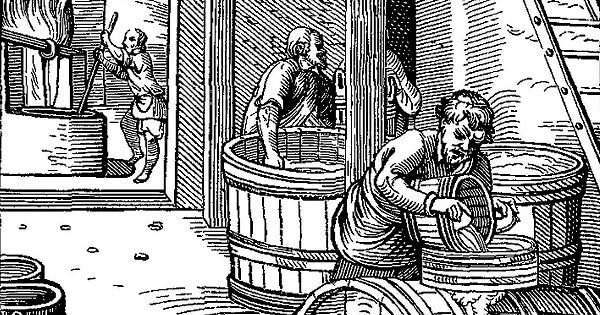
When brewing at a small scale, traditional techniques often turn out to be practical and sophisticated solutions to modern problems.
Given that the average homebrewer works with equipment that could be described as “medieval,” these methods are often particularly well-suited to homebrewing — but they can also be applied to commercial brewing.
One of the techniques that has almost disappeared from modern practice is precisely brewing through the parti-gyle method.
Parti-gyle brewing
Parti-gyle is a technique that involves extracting the first portion of the mash and using it to brew a Strong Ale or a Barleywine; then re-sparging the grain and collecting a second, weaker and more watery wort, often called “small beer.”
Back then, it was relatively easy to build large wooden mash tuns, but the technology required to build equally large kettles had not yet been developed.
As a result, English breweries of the Victorian era often brewed three beers from a single mash: a strong beer (XXX), a regular one (XX), and a light one (X).
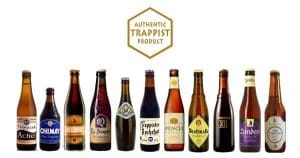
In fact, this is the historical basis for the categorization of Trappist beers. The Tripel was brewed with the first undiluted wort, the Dubbel was brewed from the runnings of a second sparge, and the Simple from the wort obtained in a final infusion.
Many medieval breweries had two or three kettles, which they first used to heat the mash water and then to receive and boil the different worts.
Other breweries simply boiled the first wort, transferred it to the cooler, re-heated water for a second mash, flooded the grain again, and collected the second wort into the kettle.
Often, the second wort was even boiled with the hops from the first batch.
The Industrial Revolution and beer
Commercial brewing evolved from a craft process to an industrial one in the late eighteenth century, driven by the technological advances of the Industrial Revolution, which made it possible to manufacture and heat larger kettles than had previously been possible.
This helped drive the great Porter beer revolution, which had begun in 1722 and established a new brewing method called “entire” — the name by which Porter beers were known during the early years of their existence.
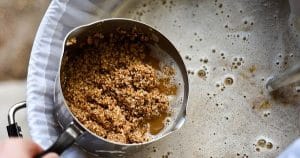
During production, all the wort was transferred to a vessel and then boiled to produce a single-gravity batch.
Its development and influence was so significant that this method remains the most widely used by homebrewers and commercial brewers today.
Those who brew large batches at home face a slightly different, though related, problem: not having enough variety of beers.
The typical 15-gallon (57-liter) batch brewed in adapted barrels allows you to produce a good quantity of beer — but unless you have a rock band living in your house, you might want more variety, especially if the beer is experimental.
Parti-gyle is therefore the technique that allows you to split the brew session and produce different types of beer in a single day: one or two additional varieties beyond what you would normally make.
This is not very different from what happened in the Victorian era, when the cost of malt was very high relative to the wages of those who consumed it.
Yet English pubs were accustomed to offering a wide variety of beers to suit the preferences of their customers.
Parti-gyle was the technical answer to this problem — not a trick, but a well-established common practice that had improved considerably over time.
The homebrewing parti-gyle method
Let’s look at an example using a 15-gallon (57-liter) setup. We mash as usual and collect the first 6 to 7 gallons (22 to 26 liters) into a smaller pot and start the boil.
Then, with about 11 to 13 gallons (41 to 49 liters), we sparge and collect into a larger pot.
It’s always a good idea to fill the mash tun with a few extra liters so the grain floats again and avoids compaction.

Generally, both pots are boiled at the same time, scheduling the boil times so that one batch is ready to cool down just as the other has finished cooling.
In practice, the stronger batch finishes first because it started first. But if a much longer boil is desired for the strong gyle, you can let the lighter batch continue its process and keep the strong wort boiling for the extra half hour needed for the lighter batch to go through cooling.

The batch can be split in different ways, but a one-third/two-thirds split has turned out to be my preferred arrangement, giving me 5 gallons (19 liters) of Strong Ale and 10 gallons (38 liters) of lower-gravity beer from a 15-gallon (57-liter) master batch.
I then ferment in 6.5-gallon (25-liter) glass carboys, which allows me to use different yeasts in each batch and obtain up to three different beers.
For a one-third/two-thirds split, roughly half of the malt extract ends up in the first third of the mash runoff, and the other half in the last two thirds.
Because the volume of the first portion is half that of the second portion and they contain the same amount of sugars, the first will be approximately twice as strong.
The commercial parti-gyle method
In a commercial microbrewery, the basic technique is similar. It requires a small secondary or decoction kettle, or at least a holding vessel to park one portion while the other is boiling.
Obviously, appropriately sized fermentation vessels would also be needed.
Recipe formulation
Naturally, brewing using the parti-gyle technique makes recipe formulation a bit more complex, especially with regard to color.
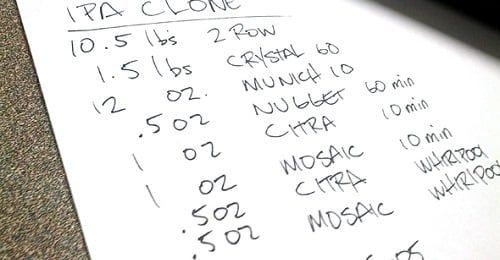
The method produces two or more batches, each with a different gravity and color — but neither represents the overall batch formulation for which the recipe must be written.
If desired, you can run a mini-mash of specialty malts alongside the main batch to provide a bit of extra color to the lighter batch.
Basic parti-gyle math
For example, a 15-gallon (57-liter) batch that yields 5 gallons (19 liters) of wort at 22°P (1.092) will also produce 10 gallons (38 liters) of wort at 11°P (1.046).
To calculate the gravity of the master batch boil, you multiply the gravity and volume of each boil (°gal), add them together to get the total boil gravity, and then divide by the total volume.
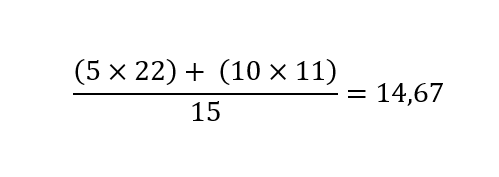
The result (14.67°P) is the gravity at which the entire batch must be brewed to achieve the desired individual gravities for each portion.
You don’t have to stick to a 2:1 gravity ratio. You can blend some of the stronger batches with the weaker ones — or vice versa — to obtain beers of similar gravity.
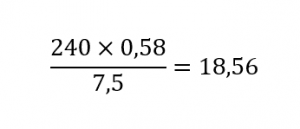
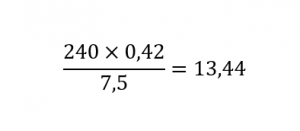
Batches split into two equal volumes have a different ratio: approximately 58% of the extract will be in the first half and approximately 42% in the second half.
For example, a 15-gallon (57-liter) master batch designed to produce 16°P wort contains:

The first half will be 18.56°P.
And the second half will be 13.44°P.
Of course, parti-gyle allows the wort to be split into more than two portions — though to obtain three batches from a single brew session, as was done in medieval times, the calculation becomes somewhat more complex.
A useful rule of thumb is that the middle batch will be approximately the same strength as the “entire” infusion.
The first runnings will be approximately 1½ times the master batch concentration, while the last runnings will be roughly half.
Therefore, a full 16°P batch will produce 5 gallons (19 liters) of beer at 24°P, 5 gallons at 16°P, and 5 gallons at 8°P.
Actual gravities will vary from batch to batch depending on many factors, but these estimates provide a solid starting point.
Frequently Asked Questions (FAQ)
1. How does the parti-gyle method affect the final color of the different beers?
In a parti-gyle, most pigments from specialty malts are extracted into the first wort. This means the first beer (the strongest) will be significantly darker than the second or third. If you want the small beer to maintain a specific color, it is recommended to perform a cold steep of dark malts or a separate mini-mash to adjust the color of the second boil without altering its gravity.
2. Is it necessary to adjust the water pH for the second and third sparges?
Yes, it is essential. As more wort is extracted, the grain’s buffering capacity decreases and pH tends to rise. If pH exceeds 5.8, you risk extracting astringent tannins from the grain husks. To avoid this, it is recommended to acidify the sparge water to maintain mash pH in the range of 5.2 to 5.5.
3. What beer styles are ideal to brew with this technique?
Historically, British and Belgian styles are the most suitable. You can brew a Barleywine or Imperial Stout with the first wort, and an English Pale Ale or Dry Stout with the second. In the Belgian context, this is the traditional basis for creating a Tripel (first wort) and a Patersbier or table beer with the last runnings.
4. Should the same hop profile be used for all batches?
Not necessarily. Although you can reuse the hops from the first boil in the second to provide base bitterness (a classic technique), the ideal approach for added complexity is to vary the additions. The first batch usually requires a more robust hop profile to balance its high malt content, while the lighter batch benefits from more aromatic and floral hops that do not overwhelm its delicate body.
5. How long can the wort be held between one boil and the next?
If you do not have two kettles, you can hold the second wort while boiling the first. However, it is vital to keep it above 75°C to prevent lactobacillus or other grain-borne bacteria from starting unwanted acidification. If the wait exceeds two hours, it is recommended to bring the wort to a brief boil (pre-boil) to sterilize it before setting it aside.