
This post is also available in:
 Español
 Português
 Français
Whenever we drink Trappist beers, the first place that comes to mind is Belgium; however, these beers originated in France, a country not exactly known for its brewing tradition.
It was there, around the year 1098, that the Cistercian Order was born (it would later give rise to the Trappists) and where this type of beer was first brewed.

Trappist Monks Spread Across Europe
Later, in the 18th century, the Trappist monks were expelled from France by the revolutionaries and fled to Belgium, Austria, the Netherlands and Germany, where they kept brewing beer as a way to cover the order’s expenses.
Unfortunately, most of these brewing monasteries were destroyed during the world wars.
Even so, whenever we hear about monks, abbeys or ancestral brewing methods, we still keep alive the romantic idea of the old breweries of the Middle Ages.
The truth is that both the buildings and the facilities where Trappist beers are brewed today date from the 19th century. They are relatively young and, much to our regret, few in number.
Trappist Monasteries
Today only eight monasteries brew beer with the ATP seal, and none of them is in France, the birthplace of these beers. The French abbey of Mont des Cats sells a Trappist beer, but it is brewed by Chimay in Belgium and therefore cannot carry the logo.
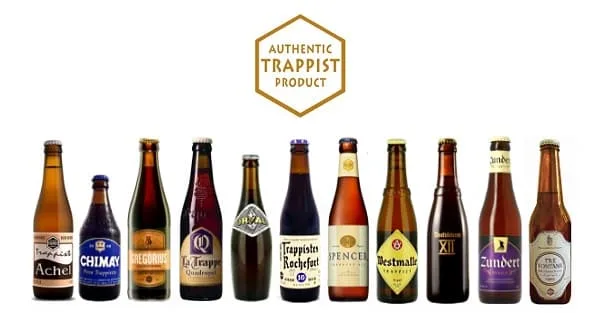
Until 2013 all of them were very close to the French border or in central Europe, with six abbeys in Belgium (Achel, Chimay, Rochefort, Orval, Westmalle and Westvleteren), La Trappe in the Netherlands and Stift Engelszell in Austria. In December 2013 they were joined by Zundert, also Dutch, and Spencer in the United States, the first outside Europe, and in 2015 Tre Fontane in Rome followed.
In 2016, when this article was published, eleven breweries held the ATP seal. As of October 2026 there are eight, after four lost their certification between 2021 and 2025 and a new abbey, Tynt Meadow in England, joined in 2018. Each change is documented in the sections below.
Authentic Trappist Product
Trappist beers can be recognized by the “Authentic Trappist Product” logo, which certifies that they have been brewed according to the criteria of the ITA (International Trappist Association) and that they can rightfully be called Trappist beers.
The requirements they must meet are varied; for one thing, they have to be brewed inside the monastery or very close to it.
At places like Chimay, although the brewing itself takes place within the abbey grounds, bottling and storage are carried out in another building outside those grounds.
In addition, production must always be under the direct control and supervision of the monks.
Finally, the main purpose of production must not be financial profit, but simply to cover the needs of the monastic community and to fund social work.
You could say the Trappists were the pioneers of the whole “non-profit” idea.
It is worth noting that some ITA monks, the purists of the order, refuse to brew more beer than strictly necessary, in their own words.
We are not brewers. We are monks, and we brew beer so that we can remain monks.
This means they cannot meet part of the demand for their products. What is more, some of these beers can only be obtained by traveling, and traveling a lot.
That is the case of Westvleteren, which can practically only be enjoyed (with a bit of luck) in Belgium.
On the other side of the coin, La Trappe can be found on the shelves of almost any supermarket in the world.
What Makes Trappist Beers Special?
Beyond meeting the ITA requirements, they are usually unfiltered and top-fermented ales, and they share a spicy, complex flavor.
They are bottled with yeast for a second fermentation in the bottle, which results in a high alcohol content.
What is more, the higher the alcohol content of these beers, the longer they can be cellared, more than ten years in some cases.
What Is the Difference Between Trappist and Abbey Beers?
People often call every beer with the word “Abbey” on the label a Trappist beer, or even those that only show the image of a monk. They are two different categories.
The former are brewed and sold in compliance with each and every one of the ITA requirements so they can display the coveted logo.
Abbey beers, on the other hand, are brewed by private brewers who acquired old recipes of medieval tradition once brewed by religious congregations that stopped producing them.
1. Bières de Chimay (Chimay)
The pioneers in displaying the coveted logo on their label. The first beer brewed at the Abbey of Notre-Dame de Scourmont dates from 1862 and was the one we know today as Chimay Red, followed by the Blue and finally the White.
Their greatest treasure? The yeast, unique in the world because in the 1950s Father Théodore isolated one of its cells.
The quality of the water is also essential, pure water drawn straight from the abbey’s wells.
The monks work only five hours a day and devote the rest of their time to seeking God through study and prayer.
Even so, they find time to produce not only one of the best beers in the world, but also a wide range of cheeses, made with milk from the cows that graze their fields, perfect for pairing with their beers.
And since man does not live by cheese and beer alone, they also run a restaurant and a hotel that is well worth a stay, not only for the surrounding landscape but also for the aroma that fills every last corner.
Chimay Rouge (Red Label)
- Style: Belgian Dubbel
- Alcohol: 7.0%
- Notes: In the 75 cl bottle it is known as “Chimay Première”.
Chimay Blanche (White Label)
- Style: Belgian Tripel
- Alcohol: 8.0%
- Notes: In the 75 cl bottle it is known as “Chimay Cinq Cents”.
Chimay Bleue (Blue Label)
- Style: Belgian Dark Strong Ale
- Alcohol: 9.0%
- Notes: In the 75 cl bottle it is known as “Chimay Grande Réserve”.
Chimay Dorée
- Style: Belgian Pale Ale
- Alcohol: 4.8%
- Notes: A lighter beer brewed for consumption within the abbey, which makes it very hard to find outside it.
Chimay 150 / Spéciale Cent Cinquante
- Style: Belgian Strong Ale
- Alcohol: 10%
- Notes: Brewed specially to celebrate the abbey’s 150th anniversary.
2. Brasserie d’Orval (Orval)
Closer to France, it takes its name from Val d’Or (Golden Valley), which, according to legend, was given by Princess Mathilde when a trout returned the ring of her late husband that had fallen into a spring.
In fact, this very symbol, the trout with the ring in its mouth, is what adorns Orval bottles.
To this day, water from that spring supplies both the monastery and the brewery, and that seems to be where its mystery lies, though not only in the water, since wild yeasts of the Brettanomyces type have also helped make it a one-of-a-kind beer since 1931.
Only one Orval beer is brewed for sale, although there is a lighter version for consumption within the monastery.
Orval Trappist Ale
- Style: Belgian Pale Ale
- Alcohol: 6.2%
- Notes: A beer with a truly unique and distinctive character, the only one brewed for sale to the public.
Petite Orval
- Style: Belgian Pale Ale
- Alcohol: 3.5%
- Notes: Brewed for internal consumption, it can only be found at a café near the abbey.
3. Brasserie de Rochefort
It started out as a convent of nuns; the brewery began operating sometime in the 16th century.
This abbey has suffered all kinds of calamities, including the French Revolution, two world wars, a plague epidemic and the Nazi occupation.
No wonder its motto is “I stumble, I rise again”. And that is not all, because in December 2010 a short circuit caused a fire that, terrible as it was, failed to destroy the brewery.
So today, and uninterruptedly since 1900, it is possible to enjoy its three classic beers, Rochefort 6, 8 and 10. In October 2020 the Triple Extra joined them, an 8.1% blonde that revives the pale beer the monks brewed only between 1920 and 1923, according to the history of the Rochefort brewery.
This is a cloistered abbey and visitors cannot enter. In fact, the brewery operates under strict observance of the Cistercian rule and brewing follows the monastic timetable, starting at half past three in the morning.
Rochefort 6 (Red Cap)
- Style: Belgian Strong Ale
- Alcohol: 7.5%
- Notes: The oldest of the three is a scarce beer, brewed only once a year.
Rochefort 8 (Green Cap)
- Style: Belgian Dark Strong Ale
- Alcohol: 9.2%
- Notes: The most recent and the beer with the largest production.
Rochefort 10 (Blue Cap)
- Style: Belgian Dark Strong Ale
- Alcohol: 11.3%
- Notes: The strongest and most representative version. You can read our Rochefort 10 tasting notes.
Rochefort Triple Extra
- Style: Belgian Tripel
- Alcohol: 8.1%
- Notes: Launched in October 2020, first in the Netherlands and then in Belgium.
4. Brouwerij Westmalle
In 1794, a group of monks was heading to Amsterdam to sail to Canada, but, as fate would have it, they ended up staying in Westmalle and founded a Trappist monastery.
At first, as is usual in these cases, the beer was brewed for the monks’ own consumption.
Years later, they began selling it at the brewery gates to fund their monasteries in the Congo, and that is how its commercial life began.
The current facilities date from 1930 and still keep the copper kettles and the ceramic decoration of the original brewery.
The first beer brewed there, in 1836, was the Dubbel, and we can still enjoy its sweet sponge-cake aroma today.
The Tripel has kept its recipe intact since 1956, and the Extra is brewed twice a year for the monks’ own use and enjoyment.

Westmalle Dubbel
- Style: Belgian Dubbel
- Alcohol: 7.0%
- Notes: Malty and fruity, the result of a three-week secondary fermentation.
Tripel Westmalle
- Style: Belgian Tripel
- Alcohol: 9.5%
- Notes: Considered the “mother” of all Tripels.
Westmalle Extra
- Style: Belgian Pale Ale
- Alcohol: 4.8%
- Notes: Brewed for consumption within the abbey, which makes it very hard to find outside it. See the Westmalle Extra tasting notes.
5. Brouwerij de Achelse Kluis (Achel)
Achel, the brewery that rose from its ashes like the Phoenix, sits on the border between Belgium and the Netherlands. The Abbey of Achelse Kluis was founded in 1656 as a place of worship and prayer.
No beer was brewed there, but since the monks were not exactly teetotalers, they bought it from other brewers in the area.
And so, praying and drinking, they carried on until 1789, the year they had to flee and abandon the abbey.
In 1846, a handful of monks from Westmalle Abbey refounded it under the name of Saint Benedictus and began to brew their own beer.
But then the First World War broke out and the Germans melted down all the equipment to make cannons.
It was not until 1998 that the monks built a new brewery (until then they brewed at other Belgian breweries), where bottling has also been done since 2001.
Achel 5 Blond
- Style: Belgian Pale Ale
- Alcohol: 5.0%
- Notes: Only available at the abbey itself.
Achel 5 Bruin
- Style: Belgian Ale
- Alcohol: 5.0%
- Notes: A dark, light-bodied beer, only available at the abbey itself.
Achel 8 Blond
- Style: Belgian Strong Ale
- Alcohol: 8.0%
- Notes: Very hard to find, even in Belgium
Achel 8 Bruin
- Style: Belgian Dark Strong Ale
- Alcohol: 8.0%
- Notes: Launched one year after the Achel 8 Blond.
Achel Blond Extra
- Style: Belgian Tripel
- Alcohol: 9.5%
- Notes: Brewed since 2010 and only available in 75 cl bottles.
Achel Bruin Extra
- Style: Belgian Tripel
- Alcohol: 8.5%
- Notes: Brewed specially for the 75th birthday of Abbot Marc Gallant.
At the end of 2020, the last monks of Achelse Kluis Abbey moved to the Westmalle monastery, leaving the abbey without an active community. In January 2021, the ITA withdrew the Authentic Trappist Product seal from Achel.
The abbey was sold to a private businessman in 2023. Beers bearing the Achel name are still produced under lay management, but no longer carry the ATP logo.
6. Abbey of Saint Sixtus (Westvleteren)
Located in Westvleteren, this is the greatest legend in the world of beer.
Its beginnings were not easy, as the monks endured financial hardship, very harsh winters and a couple of wars during which the abbey served as a field hospital, resistance headquarters and refugee shelter.
It was precisely during the Second World War that Westvleteren XII was born. Until recently it was practically impossible to enjoy these beers outside the abbey or the In de Vrede café, opposite the monastery and owned by the monks.
These beers still keep the essence and charm of the past, with bare bottles in old wooden crates.
As a curiosity, none of the Westvleteren beers carries a label and all the required information is printed on the cap, although some importers may add a label to the bottle to comply with local regulations.
Westvleteren Blonde (Green Cap)
- Style: Belgian Pale Ale
- Alcohol: 5.8%
- Notes: Available since 1999, the everyday beer of the abbey’s monks.
Westvleteren Extra 8 (Blue Cap)
- Style: Belgian Dubbel
- Alcohol: 8.0%
- Notes: Also known simply as “Westvleteren Extra”.
Westvleteren 12 (Yellow Cap)
- Style: Belgian Dark Strong Ale /Quadrupel
- Alcohol: 10.2%
- Notes: Also known as “Westvleteren Abt” and considered by many to be the best beer in the world.
7. Brouwerij de Koningshoeven (La Trappe)
Until 2013, it was the only Dutch Trappist brewery and the one offering the widest range of beers, as many as nine.
Ever since brewing began in 1884 at the Abbey of Our Lady of Koningshoeven, near the Belgian border, its authenticity as a Trappist brewery has been questioned more than once.
In the 1960s, the monks became overwhelmed with work and sought the collaboration of other breweries; however, twenty years later they took over the entire brewing process themselves again, launching the first beer under the La Trappe name.
In 1999 the day-to-day management of the brewery passed to a subsidiary of the Bavaria brewing group, which leases the buildings and equipment from the abbey. That same year La Trappe stopped carrying the Authentic Trappist Product logo.
The monks argued that when they signed with the multinational, the ITA rules were not very clear, and after much deliberation, in 2005 they were given back the right to the logo.
Today the De Koningshoeven brewery is a subsidiary of Royal Swinkels, the former Bavaria group, while the monks retain the buildings and the final say on brewing, according to its documented history. It is a Trappist brewery whose commercial side is run by a large Dutch family brewer.
La Trappe Witte Trappist
- Style: Witbier
- Alcohol: 5.5%
- Notes: Brewed with wheat.
La Trappe Blond
- Style: Belgian Ale
- Alcohol: 6.5%
- Notes: Filtered and then bottled with sugar and yeast.
La Trappe Dubbel
- Style: Belgian Dubbel
- Alcohol: 7.0%
- Notes: Brewed since 1997 with secondary fermentation in the bottle.
La Trappe Tripel
- Style: Belgian Tripel
- Alcohol: 8.0%
- Notes: Malty and estery, with secondary fermentation in the bottle.
La Trappe Quadrupel
- Style: Belgian Speciality Ale
- Alcohol: 10.0%
- Notes: The strongest of the range, also available in a barrel-aged version.
8. Stift Engelszell
The abbey is located in Engelhartszell, in the north of Upper Austria, in a narrow valley of wooded hills.
Unlike other monasteries, Engelszell is relatively small, with only about 50 hectares of forest and 40 of farmland.
Because they ran a home for the elderly and a shelter for battered women, they needed more resources, and that is how the decision to brew beer came about, inspired by the commercial success of their Belgian and Dutch colleagues.
They set up a small brewery with a capacity of 2,000 hl a year, which started with two beers, the dark Gregorius and the lighter Benno. Both were bottle-conditioned with a second fermentation.
The quantities produced were always very limited and were sold mainly in Austria and the United States.
Engelszell Gregorius Trapistenbier
- Style: Belgian Strong Dark Ale / Quadrupel
- Alcohol: 10.5%
- Notes: The first beer released in 2012, originally at 9.7% ABV, named in honor of the abbey’s first abbot, Gregorius Eisgovel.
Engelszell Benno Trapistenbier
- Style: Belgian Dubbel
- Alcohol: 6.9%
- Notes: Named after Abbot Benno Stumpf.
Engelszell Nivard Jubiläumsbier
- Style: Belgian Pale Ale
- Alcohol: 5.5%
- Notes: Brewed to celebrate the 250th anniversary of the abbey’s consecration.
In May 2023, the Order of Cistercians of the Strict Observance formally dissolved the Stift Engelszell monastery, which had dwindled to four monks.
With the religious community gone, the abbey lost the ATP seal. Beer production may continue on a lay basis, although without ITA certification.
9. Abdij Maria Toevlucht (Zundert)
In November 2013, the Abbey of Maria Toevlucht was officially named the ninth Trappist brewery.
The name chosen was “Zundert”, after the place where it is located, the municipality of Zundert in the south of the Netherlands, near the Belgian border.
For the first time in 125 years, a new Trappist brewery opened its doors in that country.
The monastery brewery currently has a production capacity of 40 hl, and its beer is described as having a strong, slightly rebellious personality, just like the abbey’s monks, not too heavy, not too dark, golden amber in color, spicy and 8% ABV.
Zundert Trappist
- Style: Tripel
- Alcohol: 8.0%
- Notes: The first Dutch Trappist beer in 125 years.
In May 2025, the abbey announced its closure due to a lack of vocations. Of the more than seventy monks it had once housed, only six remained.
The General Chapter of the Trappist Order approved the closure in September 2025. With the departure of the monks, Zundert lost the ATP seal.
10. St. Joseph’s Abbey (Spencer)
Spencer Trappist Ale, from St. Joseph’s Abbey in Massachusetts, officially became in December 2013 the tenth Trappist brewery and the first located in the Americas.
Its home is a small town of 11,000 inhabitants in the northeastern United States, and it was built with direct guidance from Chimay.
Spencer Trappist Ale
- Style: Belgian Pale Ale
- Alcohol: 6.5%
- Notes: The first American Trappist beer.
Spencer Trappist Imperial Stout
- Style: Imperial Stout
- Alcohol: 8.7%
- Notes: Full-bodied, focused on roasted malts
Spencer Trappist India Pale Ale
- Style: India Pale Ale (IPA)
- Alcohol: 7.2%
- Notes: The first American-style Trappist IPA
In May 2022, St. Joseph’s Abbey closed its brewery. The American market, dominated by local styles, proved incompatible with the Belgian-style ales the monks brewed.
Spencer had reached an output of about 4,500 barrels a year. With the closure, the first Trappist brewery in the Americas also lost the ATP seal.
11. Abbazia delle Tre Fontane
In early May 2015, the ITA officially approved the Abbazia delle Tre Fontane, located in Rome, to receive the ATP (Authentic Trappist Product) certification.
The abbey is home to the Church of Saint Paul at the Three Fountains, said to have been built on the spot where Saint Paul was beheaded on the orders of Emperor Nero.
Legend has it that when he was beheaded, Saint Paul’s head bounced and struck the ground in three different places, where springs then appeared that still flow in the sanctuary and today give the new beer its name.
Tre Fontane Tripel Birra Trappista Italiana
- Style: Tripel
- Alcohol: 8.5%
- Notes: Brewed from an old recipe and flavored with eucalyptus
12. Mount Saint Bernard Abbey (Tynt Meadow)
In 2018, the Cistercian monastery of Mount Saint Bernard, founded in 1835 in Leicestershire (England), became the twelfth brewery with the ATP seal and the first in the United Kingdom.
After more than one hundred and eighty years of monastic history, the monks decided to brew beer as a way to support the community financially.
The abbey received guidance from La Trappe to build a microbrewery on its own premises. The resulting beer, Tynt Meadow, is a top-fermented English Strong Dark Ale that departs from the Belgian profile that prevails in the rest of the Trappist family.
Tynt Meadow English Trappist Ale
- Style: English Strong Dark Ale
- Alcohol: 7.4%
- Notes: Dark brown in color, with notes of chocolate, plum and spice. The first and only Trappist beer in the United Kingdom.
Frequently Asked Questions (FAQ)
1. How Many Breweries Hold the ATP Seal?
As of October 2026, eight breweries hold the Authentic Trappist Product seal. They are Chimay, Orval, Rochefort, Westmalle and Westvleteren in Belgium, La Trappe in the Netherlands, Tre Fontane in Italy and Tynt Meadow in England. Four original members (Achel, Spencer, Engelszell and Zundert) lost their certification between 2021 and 2025.
2. Is There Trappist Beer in Spain?
No Spanish brewery holds the Authentic Trappist Product seal. The Cistercian abbey of San Pedro de Cardeña, in Burgos, has sold a Trappist beer since 2016, but it is brewed outside the monastery and therefore cannot carry the ATP logo.
3. What Happened to Spencer, the Only Trappist Brewery in the Americas?
St. Joseph’s Abbey, in Massachusetts, closed its brewery in May 2022. Its Belgian-style ales found little demand in a market dominated by American styles, and production was no longer viable. With the closure, the first and only Trappist brewery in the Americas also lost the ATP seal.
4. What Is Tynt Meadow and Why Is It Unique?
Tynt Meadow is the beer of the Mount Saint Bernard monastery in Leicestershire (England), which obtained the ATP seal in 2018. It is unique because it departs from the typical Belgian Trappist profile to offer a 7.4% English Strong Dark Ale with notes of chocolate and plum. It is the only Trappist beer in the United Kingdom and the most recent brewery to join the ITA’s active list.
5. What Is the Difference Between a Trappist Beer and an Abbey Beer?
A Trappist beer carries the Authentic Trappist Product seal, is brewed inside or in the immediate surroundings of the monastery under the direct supervision of the monks, and its profits go to support the community rather than to commercial gain. Abbey beers, by contrast, are brewed by lay brewers from recipes of monastic tradition, without religious supervision or official certification.
Recommended
- Westvleteren 12 Quadrupel: the legend of the best beer in the world
- The history of Westmalle Abbey and its renowned Trappist beers