This post is also available in:
 Español
  Português
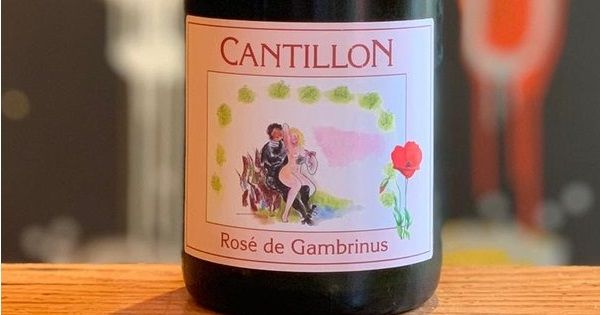
Cantillon Rosé de Gambrinus is a traditional raspberry lambic (framboise) brewed annually in Brussels, whose content usually hovers around 200 grams of raspberry per liter of beer.
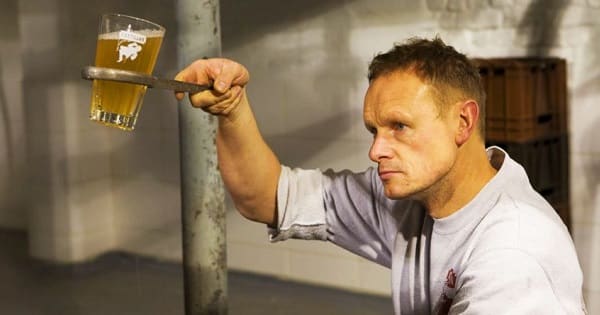
Its production uses pre-frozen raspberries mixed with a 20-month-old aged lambic, which is macerated for 1 to 2 months and then transferred to a stainless steel bottling tank, where an equivalent amount of young lambic with about 7 months of aging is added.
Contenido
The History of Rosé de Gambrinus
Brasserie Cantillon has been brewing this variety of Lambic Framboise since 1909, although the name Rosé de Gambrinus was only first used in 1986.
Over the years, Rosé de Gambrinus has undergone a notable change in its recipe. Before the 2004-2005 brewing season, it was only made with Belgian raspberries. However, because these did not add enough color, Cantillon incorporated between 5 to 10% Lambic Kriek for a time to compensate.
From then on, and due to the difficulty in obtaining enough Belgian raspberries, Cantillon began using Hungarian raspberries, which were able to provide sufficient color, so they stopped using Kriek in the final blend.
From Framboise Lambic to Rosé de Gambrinus
Although fruit beers disappeared from the brewery’s production line during World War I, during the 1920s, Kriek and Framboise were produced again for a short time until the 1930s.

Shortly after World War II, when lambic beers lost popularity and many breweries began sweetening their beers to reach a mass audience, the tradition at Cantillon disappeared.
However, it was in 1973 that Jean-Pierre Van Roy decided to start producing Framboise Lambic again when a friend of the brewery, Willy Gigounon, showed up with a shipment of 150 kilograms of raspberries.
The name Rosé de Gambrinus would later come from an artist friend who eventually proposed the name change and the new label for the beer.
The Famous Rosé de Gambrinus Label
The story of the famous Rosé de Gambrinus label dates back to 1980, when Jean-Pierre Van Roy suggested to Belgian watercolorist Albert Borret that he “bring together some artists to develop an exhibition at the brewery and celebrate the second anniversary of the Gueuze Museum in Brussels.”
Ultimately, a total of eight painters and two sculptors attended this exhibition, two of whom were his close friends Raymond Goffin and Raymond Coumans.
Due to the delicate financial situation of the brewery at the time and because the museum society was not yet well established, both Goffin and Coumans offered to produce three works each to be put up for sale for its development.
The friendship between the brewery and Coumans eventually led to, in 1985, when Jean-Pierre was working in the Cantillon cellars preparing to bottle Framboise Lambic, Coumans being “amazed by the color of the beer coming out of the barrel.”
Jean-Pierre Van Roy describes the following conversation:
Jean-Pierre, this beer has an onion-skin color. You have to call it “Rosé.”
But Raymond, that’s a name used for wine!
Then, very formally, Raymond would conclude:
Then it will be called Rosé de Gambrinus, and I will design the label.
Gambrinus, the King of Beer
The resulting label from this conversation depicts King Gambrinus, also known as the “king of beer,” who is said to have learned the brewing trade from the Egyptian gods Isis and Osiris.

In European tradition, Gambrinus is credited with inventing beer and is a legend frequently cited in countries like England and Germany as well.
On the label, King Gambrinus is depicted sitting in the middle of a garden with a nude woman on his lap who “holds a beer glass in her left hand and waits to hand it to her attentive companion only if he is worthy of what is to come.”
Export Conflicts with the United States
Starting in 1990, Brasserie Cantillon began working with Wide World Imports Inc. to export its beer to the United States, but, as expected, the original label was not suitable for North American shelves and therefore needed to be redesigned for federal approval.

Maurice Coja, director of imports in the United States, then sent a proposed label in which he had dressed the woman in a black bra and a miniskirt.
Upon seeing the reworked label, Coumans commented:
This is what is truly obscene. Tell the Yankee he can stick his suggestion where the sun doesn’t shine, and that I will draw the woman’s clothes myself.
Coumans then redesigned the label, this time with the woman wearing a large blue dress that completely covered her, not without pointing out:
Although the young woman is wearing a large blue dress, the most important thing for Americans to understand is that underneath the dress, there is still a naked woman.
It was around this time that even Playboy magazine covered the story. Later, when Shelton Brothers took over imports in 1996, the label returned to its original version.
Controversies Surrounding the Label
During the last decades and since the usage restriction in the United States, the Rosé de Gambrinus label has not been free from controversies that periodically allege supposed double standards.
Opinions remain divided; publications like the Boak & Bailey blog collect numerous records in which they ask,
Why doesn’t anyone complain about the classic Cantillon Rosé de Gambrinus woman being touched up naked on a bench?

It also mentions other articles that have raised the issue, such as Thrillist’s publication in its “Ranking of Sexist Beer Labels” or the post by Natalya Watson, a renowned beer sommelier and Advanced Cicerone, about her visit to Cantillon, where she did not attach much importance to the topic, calling it a “fun addition,” but acknowledging the difficulties women faced in the beer industry.
Then there is Jay Brooks’ beer bulletin, who stated in 2006:
I shudder every time I think about how puritanical we are as a nation and how ridiculous we must appear to the rest of the civilized world.
Even renowned beer book author Melissa Cole stated in 2008 regarding the prohibitions, defending the label and criticizing American puritanism, which had also banned the use of the image of the traditional Manneken Pis of Brussels, a 400-year-old statue.
It’s a rather pretty watercolor of a naked woman sitting on what appears to be the lap of one of those mischievous Greek gods.
However, Cole herself has confirmed years later that she feels she was wrong and that perhaps she had been too concerned about targeting one of the world’s most traditional breweries:
I’m glad to say I was wrong, and I’m very happy to say today that things need to change.
Final Conclusions
The truth is that the standard by which we judge the Cantillon Rosé de Gambrinus label today has shifted. The boundaries regarding this continue and will continue to change.
Things that seemed okay a decade ago or even a couple of years ago have taken on a new focus, and rightly so.
Even so, for many, the Rosé de Gambrinus label is not violent or sexist, but rather an almost abstract watercolor artistic piece, with a legitimate history behind it, renowned artists, and centuries of brewing traditions.
Cantillon has undoubtedly perhaps benefited from being the heirs of a beer style that was on the verge of extinction, because they are great, interesting, and mysterious in a way that almost no one can be today, and the end of the story about this label most likely has yet to be written.
Frequently Asked Questions (FAQ)
1. What is the difference between Cantillon Rosé de Gambrinus and a Kriek?
Although both are spontaneously fermented fruit beers, the main difference lies in the base ingredient. Rosé de Gambrinus uses fresh raspberries, while Kriek is made with cherries (sour cherries). Furthermore, the profile of Rosé tends to be more acidic and floral, with an intense pink color, unlike the deep red and the bitter almond touch imparted by the cherry pit in Kriek.
2. How long can a bottle of Rosé de Gambrinus be kept?
Being a fruit beer, it is recommended to consume it preferably within one to three years after bottling to enjoy the freshness and vibrant aroma of the raspberry. Although it is a Lambic and doesn’t “go bad” thanks to its acidity and low pH, over the years the fruit flavor fades and the wild, acidic notes of the grain predominate.
3. At what temperature should this Lambic beer be served?
To properly appreciate the complexity of the organic acids and fruity aromas of Rosé de Gambrinus, the ideal serving temperature is between 10 and 12°C (50-54°F). Serving it excessively cold (like an industrial lager) numbs the taste buds and hides the nuances of the wood aging and the freshness of the raspberry.
4. What does it mean that it is a “spontaneously fermented” beer?
It means that, unlike most beers where a specific yeast is inoculated, Cantillon allows the wort to cool outdoors in an open vessel (koelschip). In this way, wild yeasts and bacteria native to Brussels (such as Brettanomyces bruxellensis) naturally colonize the liquid, initiating a unique fermentation process that lasts for years.
5. What foods pair well with Rosé de Gambrinus?
Its high acidity and fruity notes make it an excellent companion for desserts with dark chocolate, cheesecake, or berries. However, it also works surprisingly well in contrast pairings with strong blue cheeses or fatty dishes like duck, where the acidity of the beer helps “cleanse” the palate between bites.