This post is also available in:
 Español
 Português
 Français
The chalice is a beer glass with a very wide mouth, thick walls, a short stem and a solid base. It is designed for intense, complex and strong beers, such as Belgian Dubbels, Tripels and Quadrupels, which are enjoyed in slow sips.
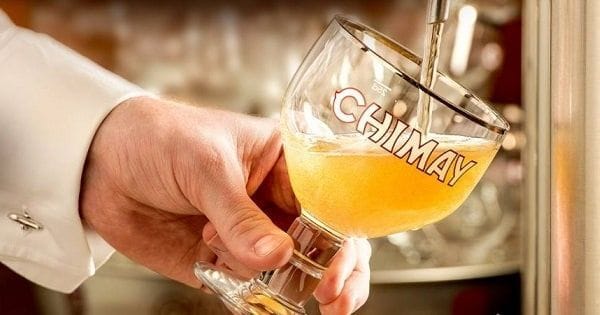
It is the glass we associate with Trappist beers. Chimay, Orval, Westmalle and Rochefort serve their beers in their own chalices. Many Belgian abbey breweries followed the same path.

What Does a Chalice Look Like?
Its shape recalls a liturgical chalice. The wide mouth lets the beer’s aroma spread over a large surface, while the thick glass holds the temperature and shows off the color of the beer.
Chalices are often highly decorative pieces, very elaborate and sometimes majestic. The most refined designs bear the brewery’s emblem, reliefs on the walls or stem and rims coated in gold or silver.
Some models have an etching at the bottom of the glass that creates a CO2 nucleation point. A continuous stream of bubbles rises from it, feeding the head and helping it last.
How Is It Different From a Goblet?
The chalice is sometimes confused with the goblet, because their shape is almost the same. The difference lies in the glass, since the chalice is thicker and heavier, while the goblet is thinner and more delicate.

Unlike a pint glass, which is designed to hold an exact amount of liquid, the chalice comes in a wide range of sizes.
Which Beers Are Served in a Chalice?
Chalices work best with robust, malty and aromatic beers, above all Belgian ales. These are the styles most often recommended for this glass.
- Dubbel
- Tripel
- Quadrupel
- Belgian Strong Dark Ale
- Belgian IPA
- Berliner Weisse
Frequently Asked Questions (FAQ)
1. What is a beer chalice?
It is a glass with a wide mouth, thick walls, a short stem and a solid base, designed for intense, aromatic beers that are enjoyed in slow sips.
2. Which beers are served in a chalice?
Mainly Belgian ales, such as Dubbel, Tripel, Quadrupel, Belgian Strong Dark Ale and Belgian IPA. It is also used for Berliner Weisse.
3. What is the difference between a chalice and a goblet?
They have almost the same shape. The chalice has thicker, heavier glass, while the goblet is thinner and more delicate.
4. Why do Trappist beers use a chalice?
Its shape evokes the liturgical chalice, a natural link for beers brewed in abbeys. The wide mouth also favors the complex aroma of these beers, and the thick glass helps keep their temperature.
5. What is the etching at the bottom of some chalices for?
It is a nucleation point. CO2 bubbles form on the etching and rise continuously, feeding the head and making it last longer.