This post is also available in:
 Español
 Português
 Français
First Wort Hopping means adding hops to the kettle while the wort is transferred from the mash tun. This technique takes advantage of the higher pH and pre-boil temperatures to achieve gradual isomerization. The result is a softer bitterness profile and a different aromatic integration.
Noble or aroma hop varieties are recommended to get an elegant background without astringency. Although calculated bitterness rises slightly, the perceived effect is less intense. This practice is common in traditional styles but is usually avoided in modern beers that prioritize highly volatile, fruity oils.
First Wort Hopping (FWH), or early hop addition, is the technique of adding a large volume of late-addition hops to the boil kettle as the wort is transferred from the mash tun.

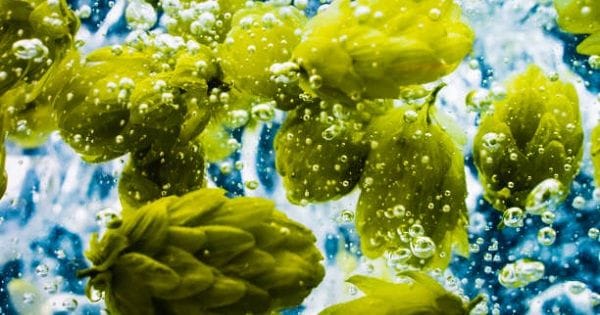
As the kettle fills, the hops steep in the wort, releasing essential oils and resins.
Normally, aromatic oils are insoluble and evaporate during the boil. However, by adding the hops before the wort boils, the oils have more time to oxidize into more soluble compounds, which means those oils are more likely to stay in the beer through the boil and deliver extra hop complexity to the finished product.
Origins of First Wort Hopping (FWH)
First Wort Hopping may well have been discovered by accident. Most likely, a brewer one day wanted to try something new and tossed the hops into the kettle before boiling the wort, then noticed a change in the flavor of the finished beer.

First Wort Hopping was a common practice in the early 20th century, typically used to increase hop utilization. But at some point in the mid-20th century, the practice was more or less discontinued.
However, in 1995 the German magazine Brauwelt reported on the “rediscovery of First Wort Hopping”, focusing on Pilsner-style beers and finding that the process produced beers with a more refined hop aroma.
The report documented that many German breweries had already adopted First Wort Hopping. In the past, brewers in England and Belgium also added hops before the boil.
The research experiment was carried out at two large German breweries. Both breweries brewed two versions of a Pilsner in very similar ways, including yeast pitching rates, water treatment, malt quantities and the use of pellet hops.
Experiment With and Without FWH
A portion of the late-addition hops (Tettnanger and Saaz) was added from the first runnings into the kettle and left in the wort for the entire boil. The final addition of aroma hops was skipped.
At Brewery A, the First Wort Hopping addition of Tettnanger and Saaz amounted to 34% of the total.
At Brewery B, which used only Tettnanger, the FWH addition accounted for about 53% of the total hops.
When the results were compared, the first beer had more IBU than the second, 39.6 versus 37.9 at Brewery A and 32.8 versus 27.2 at Brewery B.
| Brewery | IBU with FWH | IBU without FWH |
|---|---|---|
| Brewery A | 39.6 IBU | 37.9 IBU |
| Brewery B | 32.8 IBU | 27.2 IBU |
Differences in Aroma and Flavor
Yet despite the higher bitterness, the panelists described the first beers as having a more pleasant flavor and overwhelmingly preferred them, finding them more harmonious and with a more uniform bitterness than the beer brewed with conventional techniques.
Later analysis showed that the conventionally hopped beers contained higher levels of hop aroma compounds, but the panelists still described the First Wort Hopped beers as having a more refined and rounded hop flavor and aroma.
The study’s authors recommended that First Wort Hopping make up at least 30% of the total hop addition, preferably using the final aroma additions.

A later study qualifies that result. In 2017, Christina Hahn and Thomas Shellhammer, of Oregon State University, presented a poster at a hop aroma symposium held in Corvallis that compared two beers with the same amount of hops, one with FWH and the other with the addition at the start of the boil.
The panel found no perceptible sensory differences between the two at 95% confidence, although chemical analysis suggested a possible benefit for foam, as reported by Appellation Beer. It is a conference poster and not a peer-reviewed paper, so it is best read as an indication rather than a refutation.
How to Do First Wort Hopping
Today First Wort Hopping is practiced by a large number of craft brewers and homebrewers, across a wide range of styles, both Ale and Lager.
It is a very suitable technique for beers that call for noble hops, but it would not be advisable for beers that want a volatile presence of hop oils or fruity hop aromas, since its use could actually work against the development of those hop characteristics.

To do First Wort Hopping, add a substantial portion of the total hops (30-50%) to the kettle while the wort is being transferred from the lauter tun.
The hops will steep in the wort throughout the runoff and remain in the wort for the entire boil.
Be sure to use low alpha acid hops that would normally be scheduled as the final aroma/flavor additions, because isomerization begins at temperatures below boiling; more hops in the wort for longer during the boil raises the beer’s total bitterness, although the amount is still subtle because the hops are low in alpha acids.
Why Use First Wort Hopping?
First Wort Hopping takes advantage of the higher pH of the wort before the boil, which allows greater isomerization.
The reason craft brewers and homebrewers use First Wort Hopping is that it can change the beer’s hop profile, which is most easily noticed in moderately hopped beers.
However, many brewers will say that these pre-boil additions result in only subtle notes that come through even in heavily hopped beers.
The new hop flavors are not easily defined and the chemistry behind FWH is not yet fully understood, but it will normally add a 10% adjustment to the calculated IBU bitterness.
Frequently Asked Questions (FAQ)
1. How Is Bitterness (IBU) Calculated in Brewing Software When Using First Wort Hopping?
Most recipe design software (such as BeerSmith, Brewfather or Brewer’s Friend) calculates FWH by applying a mathematical multiplier to a standard 60-minute addition. Although the hops spend more time in contact with hot wort, the perceived bitterness is softer. To adjust the formula, these programs usually add an estimated 10% increase in alpha acid utilization, but mathematically it is set up by taking the total boil time (60 or 90 minutes) and changing the addition type to “FWH”.
2. At What Temperature Does Alpha Acid Isomerization Begin During FWH?
Alpha acid isomerization (the chemical transformation that provides bitterness) does not necessarily require the wort to be boiling at 100°C. It already begins below boiling point, although much more slowly, and there is no exact starting temperature. Since the wort comes off the sparge at about 75 to 78°C and takes a while to reach the boil, FWH hops contribute some bitterness during that heating.
3. What Is the Chemical Difference Between First Wort Hopping and Mash Hopping?
Although both are pre-boil additions, their impact is radically different. Mash Hopping means throwing the hops directly into the mash tun with the grain; there, much of the essential oil is retained in the grain and lost during lautering and the boil. First Wort Hopping, by contrast, is done in the already lautered wort inside the kettle, allowing the essential oils to interact with the range of hot sugars and proteins without interference from the spent grain.
4. Why Is FWH Not Recommended for Modern Styles Like Juicy or Hazy IPAs?
New England IPAs (NEIPAs) and intensely fruity beers depend on preserving highly volatile, unoxidized oils (such as myrcene). With FWH those oils go through the entire boil, during which much of the most volatile fraction evaporates. To achieve the “juicy” profile of modern IPAs, brewers prefer to avoid FWH and concentrate their additions in the whirlpool (below 85°C) and through cold dry hopping.
5. Can High Alpha Acid Hops Be Used for FWH?
Technically it is possible, but it defeats the purpose of the technique. Using high alpha varieties (such as Apollo, Columbus or Hercules) for FWH can send IBUs soaring and give a harsher bitterness than intended. FWH was designed for low alpha noble or aroma hops (such as Saaz, Tettnanger, Hallertau Mittelfrüh or Cascade), where the main goal is to transform the soluble aromatic oils and achieve an extremely round, elegant, low-intensity background bitterness.

Recommended
- What are noble hops? The heart of classic European beers
- How is beer bitterness (IBU) calculated in a laboratory?