This post is also available in:
 Español
  Português
Duvel Moortgat is a family brewery founded in 1871 by Jan-Leonard Moortgat in the town of Breendonk, halfway between the Belgian cities of Brussels and Antwerp, one of the more than 3,000 breweries operating in Belgium at that time.
In those years, the Moortgat family had acquired a farm that they later converted into a brewery, which was where they originally developed their recipes, mainly based on the trial-and-error method.
By the turn of the century, the Moortgat brewery had already achieved a certain status as producers, and their Ale beers had become a benchmark for the area.
Contenido
- Duvel Moortgat and the new generations
- The origin of Duvel yeast
- The true devil of Belgian beers
- Duvel’s evolution and growth
- International expansion and acquisitions
- How is Duvel beer brewed?
- The future of Duvel beer
- Frequently Asked Questions (FAQ)
- 1. Why is sugar added to Duvel’s brewing if Pilsner malt is already used?
- 2. What is thermal load, and how does Duvel avoid it to maintain its pale color?
- 3. Why does Duvel go through a centrifuge if it is a bottle-conditioned beer?
- 4. What is the reason for the microscopic D-shaped engraving at the bottom of the Duvel glass?
- 5. How should Duvel be served correctly to control its very high carbonation?
- Recommended
Duvel Moortgat and the new generations
In 1914, the same year World War I broke out, Jozef Moortgat, Jan Leonard’s eldest son, who had taken over the brewery, died suddenly at the age of 24.
Albert’s father, Jan Leonard Moortgat, felt he had aged too much to manage a brewery that, after 43 years, was in danger of failing.
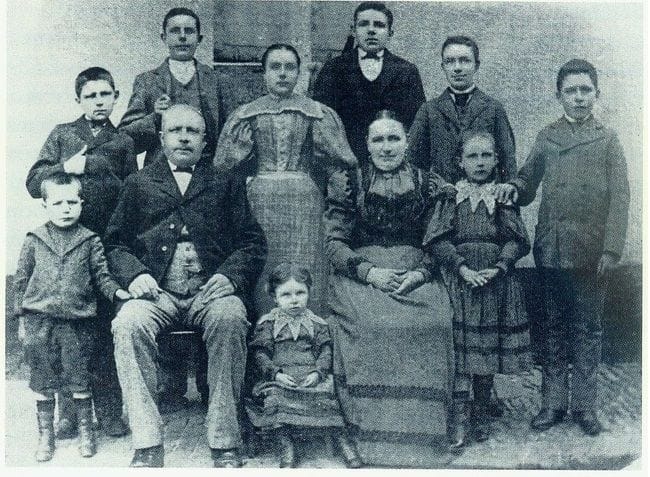
It was then that, at the age of 20, his son Albert Moortgat took over the family business, and he was soon joined by his brother Victor in 1919, who at that time was living in Brussels.
Thus, their father handed over control of the brewery to his two sons, both with specific tasks: Albert would take charge of production, and Victor would handle commercial affairs.
By then, both brothers were clear that they needed to create a new beer suitable for their generation, and that is how Duvel was originally launched in 1923 under the name Victory Ale.
Some stories suggest that its name derives from the brothers’ initials, but in the early days of its production and marketing, Victory Ale was a name commemorating the end of World War I in 1918.
The origin of Duvel yeast
One of the foundations of the iconic status achieved by Duvel beer is the mythical story of the origin of its yeast, an adventure that the brewery portrays as a unique and epic odyssey.
Unlike other family breweries that typically obtained strains from yeast banks at Belgian universities, Duvel claims that Albert Moortgat personally traveled to Scotland to select the yeast they would use to brew Victory Ale.
A comic book published by Duvel Moortgat itself recreates the story of the journey and depicts Albert traveling between the two countries with an aluminum milk can in which he supposedly transported the yeast from the William McEwan Fountain Brewery in Edinburgh.
However, some believe that the origin story of Duvel yeast is somewhat different. This is the case of Chris Bauweraerts, co-founder of Brasserie d’Achouffe, who believes that the yeast was not obtained from McEwan’s brewery, but from Younger’s brewery.
The confusion would be understandable, since by 1931 Younger’s had merged with McEwan’s to form a new company called Scottish Brewers.
Younger’s beers were also imported into Belgium at that time by the merchant John Martin, whose company was located just 30 kilometers from the Moortgat brewery in Breendonk.
Bauweraerts points out:
Brewers tend to connect. I imagine Albert asked John Martin if he could put him directly in touch with the brewery that imported the beers from Scotland, and that was the William Younger brewery.
Belgian journalist Katrien Bruyland even suggests that Albert Moortgat did not even travel to Edinburgh but simply harvested the yeast directly from some bottles of Younger’s beer in his own brewery.
Bruyland argues that it makes no sense for a technically skilled, perfectionist brewer to choose the option of making a long journey to harvest yeast in Edinburgh rather than cultivating viable yeast from a bottle of imported beer.
What is clear is that Moortgat later worked with Professor Philibert Biourge, then a world-renowned yeast expert, who is said to have combined several yeast strains from Edinburgh to use in brewing Victory Ale.
The true devil of Belgian beers
What is clear is that Victory Ale would have had a profile of aromas and flavors completely different from what beer drinkers today know as Duvel.
The current Duvel is a crystalline, highly carbonated ale of 8.5% ABV with aromas of white pepper and fresh grass from Saaz and Styrian Goldings hops, with flavors of cookie dough, honey, citrus peel, and spices, with a dry, moderately bitter finish.
Dimitri Staelens, current quality director at Duvel Moortgat, suggests that the original Victory Ale may at that time have been closer to the profile of a Belgian Scotch Ale than to the beer style that Duvel would later come to define: Belgian Golden Strong Ale.
The story goes that during a tasting at the brewery in the 1920s, a local shoemaker named Van De Wouwer passionately exclaimed “nen echten Duvel” (“a real devil”) after tasting Victory Ale.
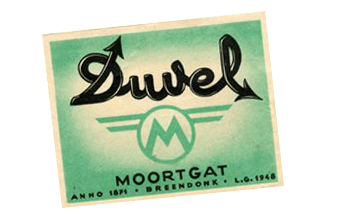
From that point on, the Moortgats decided to rename the beer with a new name, Duvel, giving the product a dangerous, mischievous, and attractive brand that would ultimately be the pillar that helped build its reputation.
However, it was only in the late 1960s and early 1970s that the beer that would become the iconic Duvel as we know it today emerged.
Emile Moortgat, a member of the third generation of the Moortgats, had developed a close collaboration with Professor Jean De Clerck, one of the most influential scientists and academics in the Belgian beer world at the time.
De Clerck, born in Brussels, had founded the European Brewing Convention and written a canonical two-volume work called Textbook for Brewing.
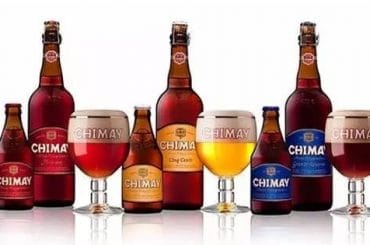
He had also helped the monks of Notre Dame Abbey create the famous Trappist beer Chimay Blue.
Thus, in the mid-1960s, De Clerck worked to isolate the strains of Duvel’s original Scottish yeast to deliver a cleaner, purer beer.
He is also believed to have been responsible for modifying the beer’s color to become a blonde ale, at a time when pale beers were becoming increasingly popular in Belgium.
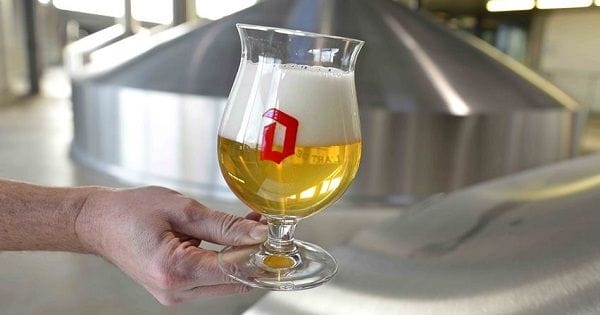
This was also the period when the brewery introduced the famous Duvel glass, becoming one of the first voluptuous tulip glasses to appear in Belgium, created with the aim of sharing functional and aesthetic elements with the Burgundy wine tasting glass.
Duvel’s evolution and growth
The fascinating evolution of the beer and the subsequent success of the redesigned Duvel defined a completely new style, the Belgian Golden Strong Ale, a beer that combines the fermentation flavors and malt character of a Belgian Tripel with the clean, dry drinkability of a German Pilsner.
Before Duvel, there was nothing like it, and the brewery continued to grow in reputation throughout the 1970s and 1980s, but it was a fourth generation of brewers from the Moortgat family that elevated it to its current global status.
The current CEO, Michel Moortgat, entered the business in September 1991, at just 24 years old.
A few months later, Michel’s father died after a battle with cancer. His mother had already passed away when he was only seven years old. Then, the following year, his uncle Emile, then CEO, also passed away.
At that time, Michel Moortgat and his brothers Bernard and Philippe inherited a large share in the brewery along with other family shareholders, but most of them did not share Michel and his brothers’ vision for the brewery’s future.
Thus, Michel’s cousins managed to get an offer from Heineken to buy their shares. But the deal would only go through if Michel, Bernard, and Philippe also sold theirs.
Instead, in an unexpected move, Michel Moortgat and his brothers decided instead to buy their cousins’ shares, taking on a huge debt to finance the purchase, using much of the company’s value as collateral.
By 1998, Michel Moortgat became CEO and, together with his brothers, owned more than half of the company’s shares. He was 31 years old.
The truth is that they had just acquired control of a financially healthy company, but one that still relied heavily on a single beer, Duvel, in a single small market, Belgium, with billions of francs in debt.
But Michel Moortgat was about to change the game. Not only would he consolidate Duvel’s reputation as an iconic beer, but under his leadership, Duvel Moortgat, the brewery this time, would itself become an iconic company.
Since 1990, when the brothers Michel, Bernard, and Philippe took control of the brewery, Duvel Moortgat’s annual commercial turnover was 30 million euros.
Thirty years later, figures at the end of 2019 show that Duvel Moortgat records a consolidated turnover of more than 500 million euros per year, directly employs more than 2,000 people, and brews 2.2 million hectoliters of beer in the process.
Duvel is now exported to more than 50 countries worldwide, its main markets being the United States, the Netherlands, France, and the United Kingdom.
Much of this growth is based on the diversification of its beer portfolio, including the purchase of several breweries in Belgium, Europe, and the US.
With this ambitious international approach, Duvel Moortgat no longer depends solely on Duvel for its survival.
International expansion and acquisitions
Despite this growth, Duvel Moortgat has successfully maintained the short chain of command and open-door policies of a Belgian family brewery that allow flexibility and rapid decision-making in response to changing market trends.

Duvel Moortgat’s purchases of other Belgian breweries continued. Achouffe, with its peculiar brand of gnomes and its characteristic beers, was the first in 2006.
Then Liefmans in 2008, an economically bankrupt brewery but still respected for its heritage in mixed fermentation beers.
Finally, De Koninck in 2010 as the producer of Antwerp’s undisputed city beer, Bolleke.
Duvel Moortgat has also extended its arms internationally. In 2001, to secure a base for growth in Central Europe, Duvel Moortgat bought a 50% stake in the Czech brewery Bernard.
In 2015, the brewery joined forces with Brouwerij ‘t Ij of Amsterdam in a commercial relationship that both described as a “partnership.”
In 2017, both breweries bought a 35% stake in the Italian brewery Birrificio del Ducato, and in 2018 they acquired a majority stake in the East London-based fermented tea brand, JARR Kombucha.
Most notably, Duvel Moortgat has purchased three breweries in the United States, each with its own personality.
In January 2003, they acquired Ommegang Brewery near Cooperstown, New York, with its American-style Belgian spirit and influence.
Later, in January 2014, it was Boulevard Brewery’s turn in Kansas City, Missouri, with its values associated with the “heart of America,” as the Midwest is known.
Finally, in July 2015, it was Firestone Walker Brewery’s turn in California, with all its West Coast style.
Due to Duvel Moortgat’s richer, farther-reaching portfolio, Duvel is now known by more people worldwide than ever before, penetrating markets it previously could not reach.
And the financial success of the other brands has allowed Michel Moortgat to invest even more in securing the technical quality of Duvel, perpetuating its status as an icon of Belgian beers.
How is Duvel beer brewed?
While the production of Duvel beer involves a range of complex processes, there are three main differentiating characteristics in its brewing that have contributed to its iconic status.
The first is the fact that it is extremely pale. The second is its fermentation profile, both in performance and flavor. And the third is its very high carbonation.
1. Appearance
First, its paleness. It is often said that people drink with their eyes, and a very light pale blonde color has been a great attraction for beer drinkers for a long time.
Part of Duvel’s iconic character, then, is that it is a beer with the attractive appearance of a Pale Lager, with barely 3 SRM on the graduated color scale.
Furthermore, Duvel is brewed only with pilsner malt, using liquid dextrose as an additional fermentable, a simple sugar that is practically completely digested by yeast.
The malt provides the biscuit notes and pale blonde color, while the sugar boosts the alcohol by volume (ABV) while maintaining a light body.
One of the most important ways Duvel brewers ensure the color is very pale is by minimizing what is called “thermal load.”
Heat darkens beer, so keeping the wort at high temperatures for even a second longer than required would result in a darker beer.
There are several examples of Duvel’s obsession with minimizing thermal load. A clear example is their mash mixers, custom-made with “Shakesbeer” technology from Steinecker.
These help the heat from the steam driven into the wort to be distributed much faster, reducing the time needed to reach target temperatures, allowing homogeneous mixing during mashing and preventing Maillard reactions such as caramelization that would darken the wort.
Additionally, Duvel Moortgat does not need a mixing arm in its mash tuns, further minimizing the risk of another cause of beer darkening: dissolved oxygen.
There are, of course, other techniques to ensure a very pale beer, such as periodic quality meetings with the three or four companies that supply the pilsner malt according to Duvel’s strict specifications.
Also, brewers do not add liquid sugar to the boil, a process that would also darken the beer; instead, it is dosed inline after this stage is complete.
2. Fermentation
The second iconic feature of Duvel is its fermentation profile, as, after styles like Geuze and Saison, Duvel is one of the driest beers in its alcohol range in Belgium.
The original gravity target is around 16.9°P, which usually ends in the region of 1.2°P, which is the measure of sugar concentration in the wort as a percentage by weight.
During the process, the yeast deeply consumes the sugars, developing that dryness; it is a very important part of what makes Duvel so drinkable and unique.
The yeast flavors, for their part, are controlled through a rigorous set of fermentation specifications.
Duvel yeast is pitched into the wort at 20°C and allowed to rise to 26°C during a four-day primary fermentation.
This is the temperature that Duvel brewers believe maximizes optimal production of esters and phenols.
Once fermentation is complete, typically after four days, the beer is cooled to -2°C for 20 days of cold conditioning, before being subjected to a centrifugal process that removes particles and hazes.
Subsequently, the liquid is bottled and refermented for two weeks in one of Duvel’s four large conditioning chambers, each 50 meters long.
Finally, the beers undergo another cold conditioning for an additional 6 weeks before going on sale.
The entire process takes about 90 days, a period of time that very few Belgian beers can match.
3. Carbonation
The third iconic element of Duvel is its extremely high carbonation, saturated at 8.5 grams of carbon dioxide per liter (4.3 volumes of CO2). More than double that of most English Ales.
Such a high carbonation level accentuates the carbonic bite on the tongue and palate, while offering a visual spectacle of enormous foam, ensuring a refreshing beer and a vibrant champagne style.
The result is a beer that has profoundly influenced the brewing of modern Belgian beers.
The future of Duvel beer
An icon is a representative symbol of something, a person or thing worthy of veneration, and Duvel has been responsible for generating a completely new style of beer.
Duvel is also iconic because its history and origins symbolize the rich family brewing heritage in Belgium and offer clues as to how Belgian beer culture has shared with other countries such as the United Kingdom and Germany for decades.
Ancient stories and the place of its production also recall the horrors inflicted on Belgium during World War II but also celebrate the advanced technical capacity of the country’s brewers and scientists.
It is also an example of how the internal tensions that family dynamics can generate in Belgian breweries, as well as the establishment of strengths that support such longevity.
Its commercial success has allowed its producers to grow and diversify, in turn ensuring continued investment in its quality and inspiring a whole wave of new beers in its mold, in Belgium and around the world.
Frequently Asked Questions (FAQ)
1. Why is sugar added to Duvel’s brewing if Pilsner malt is already used?
The addition of liquid dextrose plays a fundamental role in the design of the Belgian Golden Strong Ale. If an 8.5% ABV beer were brewed using only barley malt, the wort would contain a high amount of unfermentable complex sugars that would result in a dense, sweet, cloying beverage on the palate. By using dextrose, the Duvel yeast consumes this simple sugar almost one hundred percent, making it possible to significantly raise the alcohol content while completely drying out the beer’s profile. This gives Duvel its extremely light body, its effervescence, and its high drinkability.
2. What is thermal load, and how does Duvel avoid it to maintain its pale color?
Thermal load is the amount of accumulated caloric energy absorbed by the wort during its boiling and transfer stages. When hot wort interacts with heat for a prolonged period, Maillard reactions are triggered that darken the liquid and generate caramel or toasted biscuit flavors. Duvel minimizes this impact through advanced reactors that distribute heat ultra-rapidly and homogeneously, reducing boiling times and avoiding any unwanted caramelization to sustain its impeccable, pale 3 SRM of color.
3. Why does Duvel go through a centrifuge if it is a bottle-conditioned beer?
Unlike drastic traditional filtration, which can carry away flavor compounds and essential oils, Duvel uses a centrifugal process after cold conditioning at minus two degrees Celsius. This mechanical method applies centrifugal force to separate and expel inactive yeast cells and heavier agglutinated proteins, guaranteeing a crystalline appearance. Just before bottling, brewers reinject a micrometric dose of fresh yeast and sugar to ensure a clean, homogeneous, and predictable second fermentation inside each bottle.
4. What is the reason for the microscopic D-shaped engraving at the bottom of the Duvel glass?
The iconic Duvel tulip glass hides a technical innovation in its base: a laser-textured engraving in the shape of the letter D. This deliberate roughness acts as a nucleation point. By breaking the liquid’s surface tension in that specific area, it forces the constant, controlled release of fine columns of carbon dioxide. This is what allows its 8.5 grams per liter carbonation to remain active and to retain that massive, imposing, dense meringue-like foam crown throughout the entire tasting.
5. How should Duvel be served correctly to control its very high carbonation?
Because it has more than twice the gas of a common Ale, serving Duvel requires precision to avoid generating unmanageable excess foam. The Duvel glass must be impeccably clean, chilled, and subtly moistened. The glass should be tilted at about 45 degrees and the beer poured slowly and continuously, keeping the bottle close to the edge of the glass. As the glass fills, it is gradually straightened, and the bottle is raised to create that large characteristic foam head. The final Belgian secret consists of always leaving about a centimeter of liquid in the bottle, where the refermentation yeast settles, allowing the drinker to choose whether to pour it at the end to add haze or leave it out if they prefer a completely crystalline, crisp experience.