This post is also available in:
 Español
  Português
  Français
A few years ago, the portal Zythophile published a series of articles that quickly spread across the web and among beer enthusiasts.
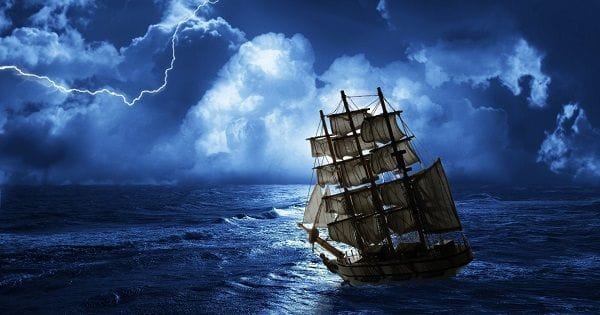

In them, on the occasion of the celebration of IPA Day, a series of myths that history had built around the origin of IPAs were debunked—claims that, to this day, are still debated to varying degrees.
Myth or reality?
The legend about the origin of IPA beers says that British brewers were looking to develop a beer to take to India, a very difficult journey for beer, as it was exposed to dramatically extreme temperatures, including two crossings of the equator. A long journey in time and distance.

It was in that context that George Hodgson, of the Bow Brewery, supposedly developed a variation of traditional English pale ale, increasing the alcohol level and adding much more hops.
This new creation was not only able to survive the journey to India, but also allegedly improved the beer, giving rise to the India Pale Ale style. At least, that’s the legend.
1. Invention of IPA
The most widely told story is that India Pale Ale was invented by a British brewer named George Hodgson from the Bow Brewery, east of London.
Hodgson was the best known of the early exporters of Pale Ales to India, but there is no evidence that he “invented” a new type of beer. Pale Ale was already being brewed in England before Hodgson.
Moreover, the beer brewed by Hodgson was not called “India Pale Ale” until more than 40 years after the first recorded export of beer to the Far East.
The first known use of the term India Pale Ale comes from an advertisement in the Liverpool Mercury newspaper published on January 30, 1835.
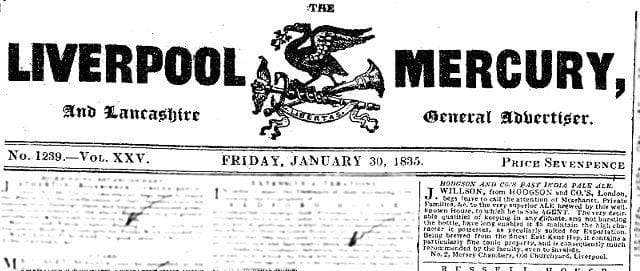
In fact, there is no evidence that IPA was actually “invented,” as it seems more likely that the style was slowly developed from existing beers and brewed under the label “Pale Ale brewed for the Indian market.”
2. Export to India
It is claimed that IPAs were born as a British export to its troops stationed in India in the 1800s.
The truth is that English pale ales appeared in the 17th century and began to be exported to India at least as early as 1780, if not earlier.
Moreover, they were not widely consumed by English troops, whether of the East India Company or later the British army in India, who preferred Porter beers, maintaining this preference until the late 19th century.
The pale ales exported by Hodgson, Bass, Allsopp, and other brewers were mainly consumed by the upper-middle classes of Europeans settled in India, military officers, and civil servants working for the East India Company, trading, administering, and collecting taxes.
3. More hops and more alcohol
British brewers supposedly discovered that if they brewed beers with higher alcohol content and added more hops to the beers they were exporting, they would not spoil during the four-month voyage around Africa.
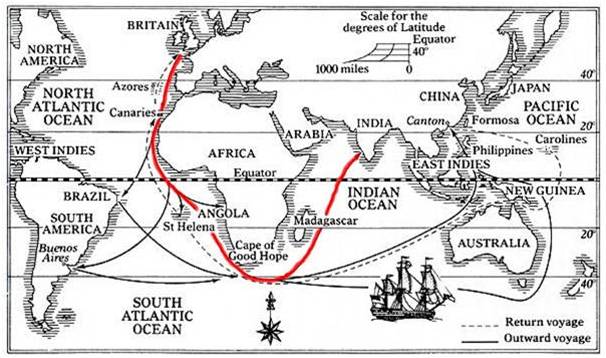
The truth is that beer did not need more alcohol to survive the journey to India, and “IPAs” were not particularly strong at that time, reaching only between 6 and 6.5% alcohol (ABV).
Certainly, by the 1760s, brewers were told that it was “absolutely necessary” to add extra hops to beer if it was to be sent to a warm place.

But this was not limited to India, and there is absolutely no evidence that George Hodgson introduced the idea of extra-hopped beers for export with more force than beers for local consumption.
4. Shipwreck in Scotland
Another popular myth about IPAs is that some ships carrying beer bound for India shipwrecked on the coast of Scotland, giving the inhabitants of this place the opportunity to taste the beers they were carrying.
The secret had been discovered, and IPAs became a staple of consumption in the United Kingdom from then on. Again, there is no record of any shipwreck associated with the transport of IPA beers in the United Kingdom.
Beers “Pale Ale expressly brewed for the Indian market” and “suitable for warm climates or home consumption” went on sale in London in 1822 without requiring a shipwreck.
IPA did not take off in Britain until around 1841, after the railway reached Burton upon Trent, which made it much easier for brewers there to send their bitter beers to markets across the UK.
5. Porter and Stout
It has been incorrectly stated that Porter and Stout were not suitable beer styles for India’s torrid climate.
The truth is that large quantities of porter (undoubtedly much more porter than IPA) were exported to India from at least the second half of the 18th century until the late 19th century.
It was even common for the East India Company to ask brewers to submit bids to supply porter that would be sent to India.
6. American IPA vs. English IPA
Lastly, it is commonly said that North American brewers adhere better to the specifications of early IPAs than British brewers.
In reality, American IPAs use types of hops that were completely unknown to British brewers in the 18th and 19th centuries, with primarily floral and citrus characteristics, meant to be drunk relatively fresh.
Early British IPAs were designed to be consumed with more aging—up to nine months or more—and while they certainly must have been bitter, they would have already lost most of any hop aroma they originally had.
Moreover, it is increasingly clear that early British IPAs would have shown at least some Brettanomyces character, given their long stay in barrels.
So, aside from both containing a lot of hops and being of similar colors, modern North American IPAs and original British IPAs could not be more different.
Frequently Asked Questions (FAQ)
1. What is brewing water burtonization?
It is the addition of calcium sulfate (gypsum) to brewing water to mimic the mineral profile of Burton upon Trent, which enhances hop bitterness and improves beer clarity.
2. What is dry hopping used for in an IPA?
It consists of adding dry hops during secondary fermentation to enhance the fresh aroma of the beer without adding additional bitterness.
3. How many IBUs does an average IPA have?
A modern IPA typically ranges between 40 and 70 IBUs, although variations such as Imperial IPA can exceed 100 IBUs of bitterness.
4. At what temperature should an IPA be served?
The ideal temperature is between 7 °C and 10 °C; if served too cold, the volatile hop aromas are lost.
5. What foods pair best with an IPA?
It pairs with spicy or seasoned dishes, grilled meats, and aged cheeses, as hop bitterness cleanses the palate of fat.

We Recommend
- Ramazzotti Violetto: Recipes to enjoy a perfect Italian aperitif
- What is a beer growler? History, meaning, and advantages of use